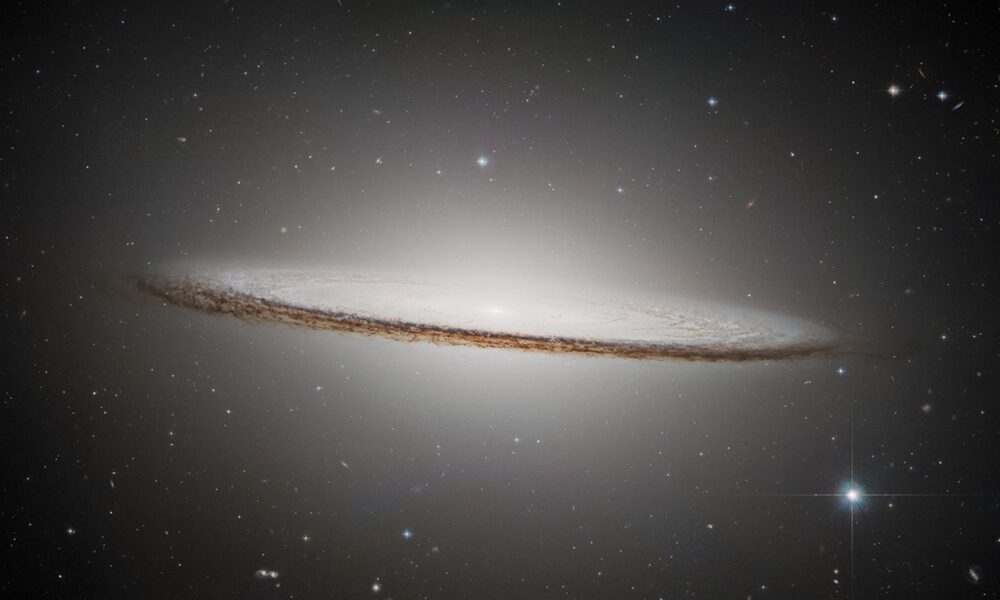

The Sombrero Galaxy, also known as Messier 104 (M104), is a galaxy in Virgo about 30 million light-years from Earth. From our viewpoint it resembles a wide-brimmed hat: an unusually bright, rounded central bulge is crossed by a thin, dark lane of cosmic dust. NASA’s Hubble Space Telescope released a new detailed mosaic of M104 in April 2025, and its Spitzer telescope previously showed that the galaxy’s structure becomes surprisingly different when studied in infrared light. It is a real galaxy, not a nebula or a digitally invented astronomical scene.
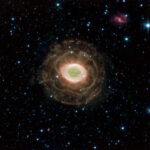
The two images here are authentic NASA telescope observations, locally hosted in AVARIXO’s Media Library: Hubble’s 2025 visible-light view and a 2012 Spitzer infrared composite. Comparing the two helps answer why Sombrero looks edge-on, where the dust ring comes from, how far away the galaxy is, and why astronomers debate whether it should be treated as a straightforward spiral or a more complex bulge-and-disk system.
Sombrero Galaxy facts at a glance
| Question | Research-backed answer |
|---|---|
| Other designations | Messier 104, M104, NGC 4594 |
| Constellation | Virgo |
| Distance | Approximately 29–30 million light-years |
| Visible shape | Large central bulge crossed by an almost edge-on dusty disk |
| Width quoted in Hubble overview | About 50,000 light-years, depending on which outer structures are counted |
| Distinctive feature | Sharp dark dust lane resembling a hat brim |
| Visible-light image in this article | Hubble mosaic released April 16, 2025 |
| Infrared image here | Spitzer view released April 24, 2012 |
| Can you see it unaided? | No; a suitable small or modest telescope is recommended |
NASA’s 2025 Hubble image record provides the new distance figure and credits, while its older overview quotes about 29 million light-years and describes the 50,000-light-year span. Approximate distance estimates differ across studies and should not be presented as if the galaxy shifted one million light-years between observations.
What does the Sombrero Galaxy look like in real Hubble photographs?
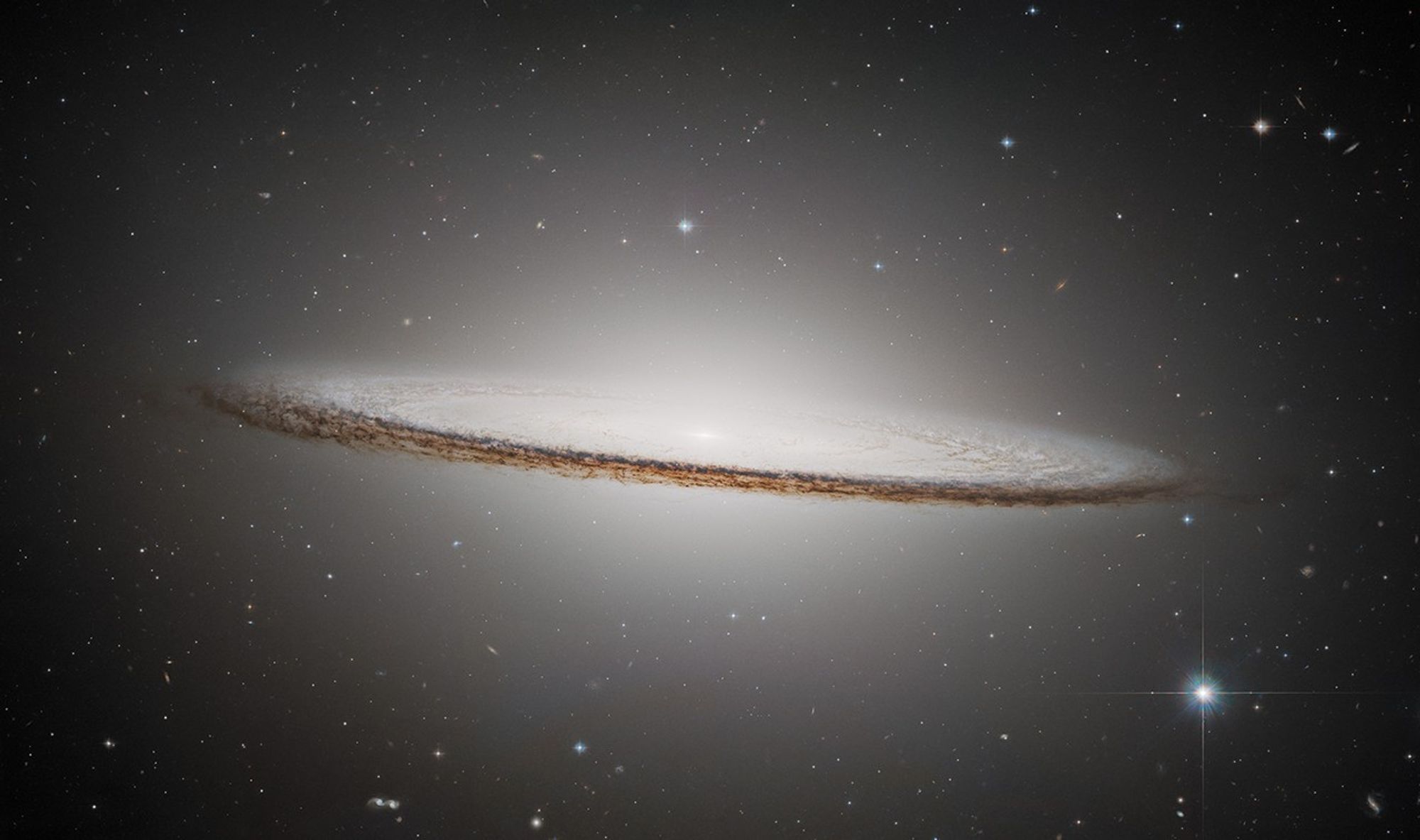
From Earth, M104’s flattened disk lies nearly edge-on to our line of sight. A giant spheroidal concentration of stars produces the pale glowing bulge, while a band of foreground dust absorbs light from stars behind it. The overall outline resembles the brim and crown of a traditional Mexican sombrero, hence the familiar nickname.
The featured image below is a genuine Hubble 2025 mosaic created from observing program 9714 and released April 16, 2025. Its bright core is not a star: it is the combined light of numerous stars in the galaxy’s central region. Individual bright points around the frame can be foreground Milky Way stars or more distant background galaxies, so not every visible dot necessarily belongs to M104.
Why does M104 have a dark stripe across its middle?
Interstellar dust inside the galaxy’s disk blocks some of the background starlight. Because we see the disk at a very steep angle, the dusty material piles up visually into a high-contrast lane near the equatorial plane of the bulge. Dust in galaxies contains tiny solid particles, unlike the denser rock we see on the ground. These particles absorb and scatter light, making the lane appear almost black against the luminous stars behind it.
The darkness does not imply a black hole is stretching across the whole disk or that the central region has stopped producing light. A supermassive black hole is believed to lie in the galaxy’s center, but it is a far smaller region than the galaxy-wide dust lane. The galaxy itself has a complex stellar history and much of its disk is not a hotbed of vigorous star formation.
What did the new 2025 Hubble image show?
NASA’s April 2025 release revisited the iconic galaxy with observations resolving its luminous bulge and the detailed structure of the dusty rim. Hubble’s narrow field of view means the large image required several pointings stitched into a mosaic. NASA places the galaxy about 30 million light-years away and notes that its ongoing star-formation rate is relatively modest compared with many active star-forming galaxies.
Do not confuse the observation date with the date the galaxy’s light was emitted. If an image was released in 2025, it records light that spent roughly 30 million years traveling to Earth. Thus no telescope image offers an instantaneous live broadcast from the galaxy.
Why does Spitzer’s infrared version look different?
Infrared radiation passes through some dusty regions more effectively than visible light, allowing astronomers to trace both the luminous underlying stellar distribution and the behavior of dust. NASA’s Spitzer Space Telescope combined measurements at different infrared wavelengths into a composite that gives a different view of the galaxy’s structure, showing a broad spheroidal bulge and a thinner disk embedded within it.
The image below is NASA Photojournal PIA15426, a real infrared observation released in April 2012. It maps infrared light into colors our eyes can interpret; the colored components are scientifically assigned rather than literal naked-eye colors. It does not mean the Sombrero Galaxy turned blue or red between the Hubble and Spitzer observations.

The different wavelengths matter. Hubble reveals the dust silhouetted against background stars; Spitzer can highlight cooler material and structures harder to see through obscuration. More detail about the instrumental distinction appears in NASA’s Spitzer PIA15426 record.
Is the Sombrero Galaxy a spiral or elliptical galaxy?
It has long been commonly classified as an early-type spiral or disk galaxy because of its prominent dark disk and central bulge. However, Spitzer observations led researchers to describe it as having a large elliptical-like stellar component with a disk nested within. This is why some astronomy articles describe its type differently. Classification is a description of the stellar structure and history, not an argument over whether the galaxy itself exists.
NASA’s Spitzer study specifically emphasizes that an infrared image complicates the simple “thin spiral disk with one large bulge” picture. The galaxy may have undergone past mergers or interactions that built up its stellar distribution. The most precise beginner description is a bulge-dominated galaxy with a distinct edge-on dusty disk.
How big is Sombrero and how far away is it?
NASA’s classic Hubble guide describes an approximately 50,000-light-year width for its prominent stellar disk, while the distance is around 30 million light-years. Those measures describe different things: width is the spatial span of the object, while distance is how far the object lies from the observer. Because the outer halo is more diffuse than the bright disk, the measured galaxy size can depend on how far out a survey detects faint stellar light.
A galaxy does not become physically small just because it appears as a thin sliver from Earth. The Sombrero’s near-edge-on orientation compresses our view of its disk but does not shrink the disk’s real diameter.
Is there a black hole in the Sombrero Galaxy?
Astronomers have found strong evidence of a supermassive black hole in the galaxy’s core from the motions of stars and gas. The black hole is not the dark ring seen in images. Rather, it is concentrated near the central bulge and its effects are inferred dynamically.
Some estimates of the central black hole’s mass have changed as observation techniques and models improved, so repeat exact numbers only with a dated scientific source. NASA’s 2025 overview describes a massive central black hole while noting that the galaxy is comparatively quiet in terms of active star formation.
How can you observe M104 with a telescope?
- Use a star chart to locate the southern part of Virgo near the Virgo–Corvus border. The sky’s orientation changes with observer latitude and time.
- Pick a dark, moonless night. A faint galaxy can disappear into light pollution even when the telescope’s aperture is adequate.
- Start with low or medium magnification to identify the extended oval glow rather than searching only for a tiny bright point.
- Look for the elongated shape and a bright central region. The dust lane may require better sky conditions or larger optics.
- Compare the field with a reliable chart to confirm the target instead of assuming every fuzzy object in Virgo is the Sombrero.
Unlike the Orion Nebula, a bright emission cloud within the Milky Way, Sombrero is a separate external galaxy. For a different nearby spiral orientation, our Triangulum Galaxy M33 guide shows a much more face-on view. Their distinct orientations help explain why galaxies can look so different in the sky despite belonging to broadly similar structures.
Frequently asked questions
Why is the Sombrero Galaxy called M104?
It is cataloged as Messier 104. The Sombrero nickname comes from its resemblance to a broad-brimmed hat.
Can you see it with the naked eye?
No. It is too faint for ordinary unaided-eye observing and is best approached with a suitable telescope.
Is the dark line a black hole?
No. It is a band of interstellar dust in the galaxy’s disk, viewed nearly edge-on.
How far away is the Sombrero Galaxy?
Approximately 29–30 million light-years, depending on the source and rounding.
Is M104 part of our Milky Way?
No. It is a separate galaxy in the direction of the constellation Virgo.
Are the pictures in this article real?
Yes. They derive from authentic Hubble visible-light and Spitzer infrared data; processed colors in the infrared image represent measurements.
Does the Sombrero Galaxy form new stars?
Yes, but its present star formation is comparatively low. Much of its light comes from older stellar populations in the large bulge.
Sources and original image credits
Photo 1 is the actual April 2025 Hubble mosaic, credit ESA/Hubble & NASA, K. Noll. Photo 2 is the actual 2012 Spitzer infrared record PIA15426, credit NASA/JPL-Caltech. Both are locally stored in AVARIXO’s WordPress Media Library with appropriate image source metadata and ALT text. Additional structural information follows NASA’s original Hubble Sombrero overview and visible/infrared comparison. Credit details are preserved and no institutional endorsement is implied.