
Good 1v1 defending in soccer starts with slowing the attacker, protecting the route to goal, and choosing the moment to challenge. The defender does not have to win the ball on the first step. Often the best immediate result is forcing the dribbler wide, giving teammates time to recover.
Here is a practical guide to stance, spacing, decision-making and repeatable drills for coaches and players. It applies to fullbacks facing wingers, center-backs dealing with breakaways and midfielders defending open space.
The five decisions behind strong 1v1 defending
1. Recover goal-side before chasing the ball
When you are beaten in transition, run back toward the direct route to goal rather than chasing the opponent’s heels. Work to place your body between the attacker and the dangerous central lane. An outside defender may need to delay while another defender covers the space behind.
2. Approach fast, then decelerate
Close the gap while the pass travels or the attacker takes a heavier touch. Shorten the final steps before reaching tackling distance. Sprinting straight through the opponent’s space often leads to being beaten by a change of direction. Decelerating gives you a chance to react.
3. Use an angled, balanced stance
Keep a comfortable athletic posture: knees bent, weight centered, and shoulders turned slightly rather than square. The exact angle depends on the touchline, the attacker’s preferred foot, the location of teammates and the risk of a shot. A defender near the left side of the penalty area may aim to show the ball carrier outside rather than into a central shooting lane.
The FIFA Training Centre describes this explicitly in its 1v1 session on orienting an attacker away from goal, emphasizing low side-on body shape, approach angle and the choice between engaging and maintaining distance.
4. Watch the ball, hips and space—not every trick
Look for a heavy touch or a ball pushed too far from the attacker’s feet. Do not lunge at the first feint. The dribbler may step over or change shoulder direction while keeping the ball close enough to accelerate away. A defender who maintains balance can survive the first trick and pressure the next touch.
5. Tackle when the situation favors you
The moment to tackle may come after a long dribble touch, when the attacker turns back, when the touchline reduces their options, or when a teammate provides cover. If the opponent still controls the ball at speed and has room to change direction, delaying can be the higher-percentage choice. Winning a 1v1 also includes forcing a safe sideways pass; a sliding tackle is not required.
How to defend a fast winger near the sideline
Fullbacks frequently face a winger who wants to cut inside onto a stronger foot. The defender should manage the distance carefully and recognize nearby cover. If the center-back is guarding the inside channel, the fullback can angle the attacker toward the touchline; if cover is absent, the defender may need to protect the center even more conservatively.
Keep glancing at the attacker’s supporting runner. Defending only the dribbler can leave an easy pass into the channel behind you. The challenge is balancing pressure on the ball with awareness of the next pass.
Four 1v1 defending drills for practice
Drill 1: Guide the attacker outside
Mark a 12-by-15-yard channel with a central mini-goal for the attacker and an outside exit gate. The defender starts a few yards from the attacker. The defender earns a point for directing the attacker through the wide exit or forcing them to retreat. The attacker scores by dribbling through the central gate. Work in short bouts with full resets so both players can focus on one decision per repetition.
Drill 2: Approach-and-brake
A coach serves a ball to an attacker positioned 10 yards away from the defender. The defender accelerates toward the pass, then brakes into a balanced stance before the attacker takes a second touch. Start without tackles so players can practice the approach. Progress to active duels once the defender can close space without overcommitting.
Drill 3: Touchline trap
Use one sideline of the field as a natural boundary. The attacker begins with the ball and has eight seconds to dribble through either of two end gates. The defender tries to guide the attacker toward the sideline and steal only when the next touch becomes exposed. Do not reward reckless contact. Rotate sides so defenders practice using both feet and body orientations.
Drill 4: Recovery run into 1v1
Start the defender a few steps behind the attacker and serve a through pass forward. The defender must sprint to regain a goal-side angle, then slow down to block a shot or pass. Introduce a second recovering defender as a progression. This connects individual defending with the collective rest-defense structure that helps manage counterattacks.
Three mistakes coaches should correct
- Standing square: an attacker can exploit a flat stance. Encourage a slight angle and short adjustment steps.
- Stabbing for the ball: a rushed foot leaves the defender off-balance. Focus on distance first, then tackle the loose touch.
- Defending without cover awareness: showing the attacker wide is not always correct if the dangerous space is actually outside. Communicate which lane teammates can protect.
How to measure progress
Record more than tackles: note how often the attacker enters the central lane, how many shots are allowed and whether the defender forces play away from danger. Film a few short duels from the side and ask the defender to explain their chosen angle. Successful defending is repeatable decision-making, not just athleticism.
FAQ
Should a soccer defender always force a winger onto their weak foot?
No. Weak-foot preference is one factor, but the safest direction depends on goal position, supporting runners, available cover and match context.
When should you jockey instead of tackling?
Jockey when the ball is under close control and the attacker can still change direction. A tackle becomes safer after a heavy touch or when teammates have narrowed the available space.
Is winning possession the only way to win a 1v1?
No. Delaying an attacker, forcing a backward pass or preventing a shot can be a successful defensive outcome.
Verified coaching basis: FIFA Training Centre — Defending in 1v1: Orientating attackers away from goal (published September 30, 2025). Drill distances and scoring variations above are original AVARIXO practice suggestions.
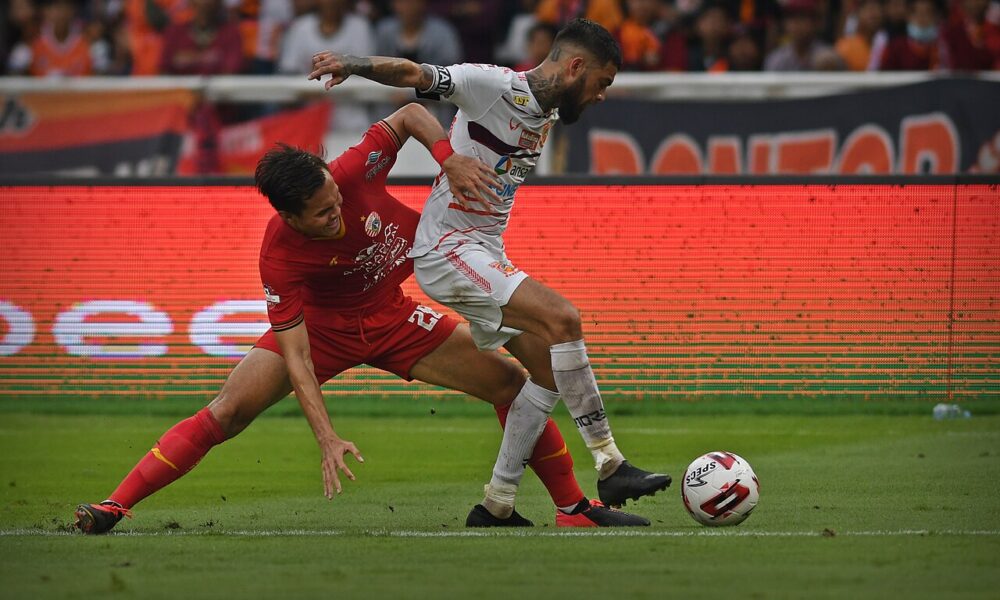
Featured photo: Adityadandito, Persija–Borneo match duel, CC BY-SA 4.0; no substantive changes to the photograph.