
In the NBA, the shot clock normally gives a team 24 seconds to attempt a field goal after gaining possession. A legal try must leave the shooter’s hand before the clock expires and then hit the rim or go through the basket. Not every stoppage returns the clock to 24: certain offensive rebounds and defensive fouls produce a 14-second reset instead.
The authority for these details is NBA Rule No. 7: Shot Clock, checked October 11, 2026.
Shot clock vs. game clock
The shot clock limits a single possession, while the game clock counts down the minutes remaining in a quarter. A team can have 7 minutes left in the quarter but only 5 seconds left to take a shot. The two timing systems are connected by officiating procedures, but they answer different questions.
After the defense gains a new live-ball possession, the new offensive team generally gets a fresh 24-second clock. After a made basket, the incoming team gets its own possession and a fresh count when the rules say play has restarted.
What must happen before the buzzer?
A shooter cannot wait until the display reaches zero and then release the ball. For a successful attempt before the horn, the ball must leave the shooter’s hand before the shot-clock signal and then touch the rim (or go into the basket). The rule distinguishes hitting the rim from striking only the backboard. A backboard-only airball does not reset the shot clock.
If the ball is still in a player’s hands when time expires, the possession ends with a shot-clock violation. If a legal shot is already in flight, officials judge what happens next under the rule’s continuation language.
Why does the shot clock sometimes reset to 14?
When the attacking team regains the ball after its own shot hits the rim, the NBA uses a 14-second reset rather than restarting a full 24 seconds. Certain defensive fouls or violations also call for a 14-second reset when the offense keeps possession in its frontcourt; exactly which value applies depends on the event and how much time remained.
Think of it this way: a new possession is different from a continuation of the same team’s attack. Read the restart conditions in Section IV of the official NBA rulebook before treating every whistle as an automatic reset.
Three examples from a normal possession
- Catch a pass with 4 seconds remaining: a shot must be released in time. The pass itself does not refresh the shot clock.
- Three-point shot hits the rim and offense rebounds: the team receives a new 14-second count under the offensive-rebound rule.
- Shot misses everything, same team recovers: no rim contact means no automatic rebound reset. If the clock expires, it is a violation.
How a violation differs from other basketball infractions
A shot-clock violation normally awards the ball to the other team, rather than granting free throws for a shooting foul. It is distinct from the double-dribble violation and the three-second lane rules, each of which has its own trigger. It is also separate from the traveling rule.
League, college and youth competition clocks can differ. Do not assume that an NBA 14-second reset instruction automatically describes a local school league’s rules.
Frequently asked questions
Does an airball reset the shot clock?
No. Missing both the rim and basket does not by itself give the offense a fresh shot clock.
Is an NBA shot clock always 24 seconds?
No. A 14-second reset can apply after qualifying offensive rebounds and specified stoppages.
Does touching the backboard count as touching the rim?
No. The rule explicitly focuses on ring contact or a made goal.
Official sources and photo credit
- official.nba.com official rules or guidance (checked October 11, 2026)
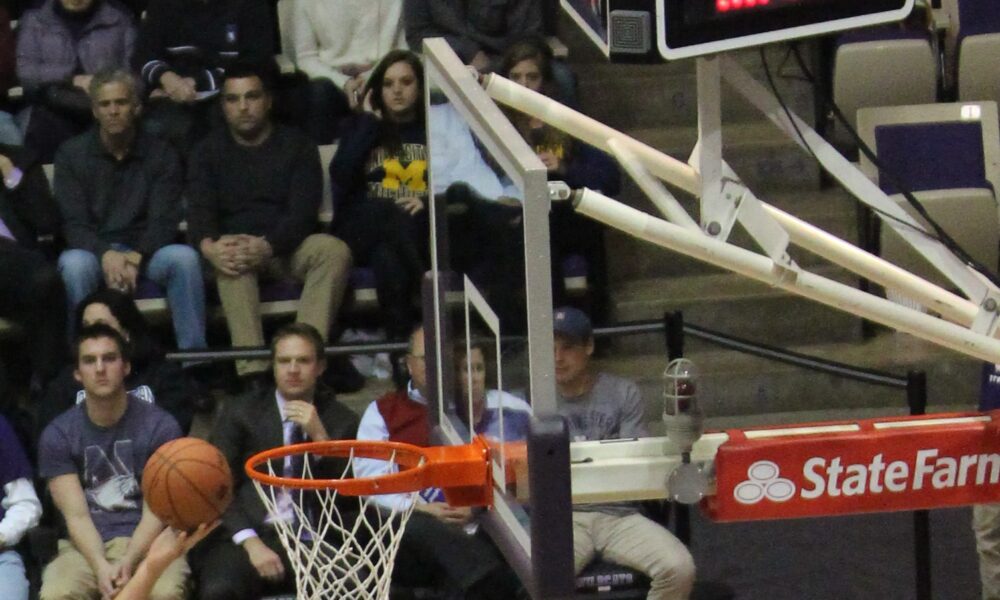
- Featured photo by TonyTheTiger. Original Wikimedia Commons file; Creative Commons license. No modifications made.

Other Articles
Advantage Rule in Soccer: Why Referees Let Play Continue