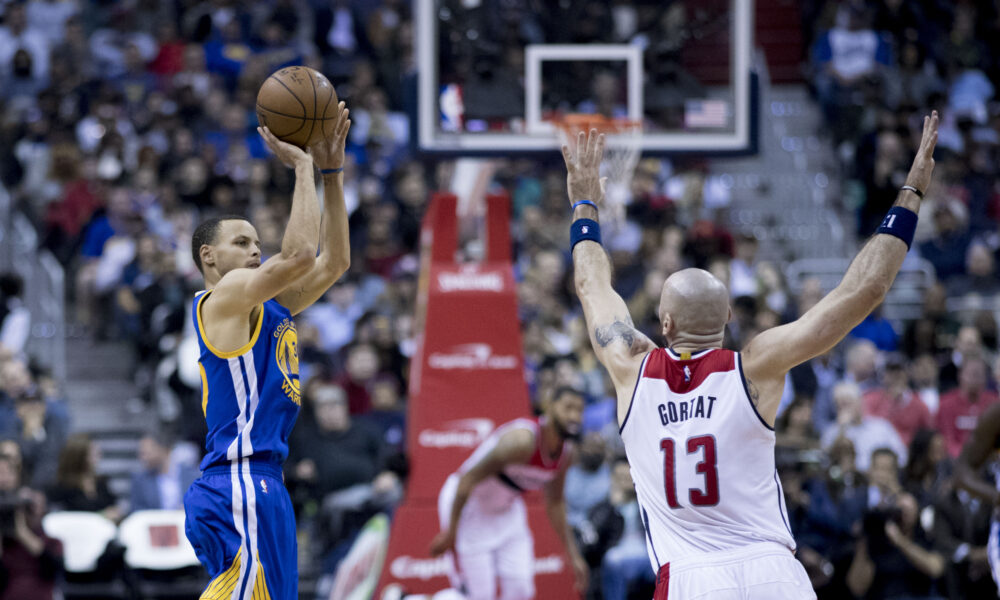

Goaltending in the NBA is an illegal touch of a shot in certain protected situations, especially when the ball is descending toward the basket with an opportunity to score. Basket interference is a broader category covering prohibited contact with the ball, rim or basket around a scoring attempt. The key is not simply whether a defender jumped high: the ball’s position, direction and contact with the backboard or rim matter.
These rules are set out in the NBA’s official Rule 11, checked October 11, 2026. The explanation below focuses on NBA games; college and international interpretations can differ.
Goaltending vs. basket interference at a glance
| Situation | Likely ruling | What the official examines |
|---|---|---|
| Defender blocks an upward-rising shot before protected backboard contact | Potentially legal block | Flight path, other restrictions and timing |
| Defender touches a descending shot with a chance to score | Defensive goaltending | Shot descending, opportunity to score |
| Player touches ball directly above rim inside basket cylinder | Basket interference | Whether it is in the protected cylinder |
| Player grabs or vibrates rim to change ball’s bounce | Basket interference | Rim contact and resulting interference |
| Ball resting or rolling on rim and player contacts it illegally | Basket interference | Location and contact at rim |
When is blocking a shot legal?
A defender can normally meet the ball while it is still rising on an ordinary shot, provided the contact does not violate the cylinder, backboard, rim or other rules. That is why elite shot blockers try to time their jump as the attacker releases the ball. If the defender instead touches the shot on its downward flight when it has a chance to score, NBA Rule 11 prohibits the interference.
There is a particularly important backboard provision: on a field-goal attempt that has a chance to score, touching the ball after it contacts any part of the backboard above rim level can be prohibited even if the ball’s immediate movement looks upward or sideways. The NBA rule is more specific than the popular shortcut “anything above the rim is a goaltend.”
What is the imaginary cylinder above the hoop?
Imagine extending the basket ring vertically upward into a cylinder. NBA players cannot legally touch the ball from within the playing area when it is above the ring inside that cylinder. The violation can occur without a defender tapping the backboard; ball position is enough. Some exceptions to rim contact exist, so an official must judge the whole play instead of simply freezing one frame.
What points are awarded for defensive goaltending?
If a defender illegally interferes with an opponent’s field-goal attempt, the shooting team is normally awarded the value of the attempt: two points from the two-point area or three points from beyond the arc. The basket does not have to physically fall through the net. The scorer is credited as specified under Rule 11.
When the offence is by the attacking team at the opponent’s basket, the attacking team cannot earn the points through that illegal contact; possession and restart are administered under the league’s rule. Simultaneous violations and own-basket interference have separate handling. This is one reason box-score discussions should distinguish a made field goal from points awarded for interference.
Goaltending vs. fouling the shooter
Goaltending concerns illegal interference with the ball or goal, while a shooting foul concerns illegal contact with the shooter. A play may feature different potential violations; it is not correct to call every blocked shot a technical foul. Review our basketball fouls guide and double-dribble explanation for the different categories of NBA whistle.
Four game situations to test yourself
- A center swats the ball as it rises before touching the backboard: typically a clean block if no other condition applies.
- A defender touches a descending three-point try that could score: defensive goaltending; the shooting team can receive three points.
- The ball is directly above the ring inside the cylinder: do not touch it; basket interference rules apply.
- A player shakes the rim to alter a bouncing ball: interference can be called even without touching the ball.
Frequently asked questions
Can a defender block the ball after it hits the backboard?
Not necessarily. NBA Rule 11 protects certain field-goal attempts after backboard contact above ring level, so a block that looks ordinary can be illegal.
Does goaltending count as a personal foul?
Not automatically. It is a basket-interference/goaltending violation under its own rule; any separate illegal player contact is evaluated independently.
Does the shot need to be directly over the hoop?
No. Goaltending on a descending ball with an opportunity to score can occur away from the exact cylinder, while the cylinder restriction addresses another category of interference.
Does NBA goaltending apply to free throws?
The NBA also has restrictions on interference during free throws; the above examples focus primarily on live field-goal attempts. Consult Rule 11 and the free-throw rules for the precise restart.
Source and image credit
- NBA Official Rule 11 — Basket Interference and Goaltending, checked October 11, 2026.
- NBA Rule Authority explanatory examples.
- Featured basketball action photo by Keith Allison, Wikimedia Commons, CC BY-SA 2.0. No manual changes.

Other Articles