
Quick answer (October 15, 2026): NASA’s Mars Exploration Rover (MER) mission sent two six-wheeled robots, Spirit and Opportunity, to opposite sides of Mars. They launched in 2003, landed in January 2004 and searched rocks and soil for signs of past liquid water. Both were designed for only 90 Martian days (sols), yet Spirit operated for more than six years and Opportunity for over 14 years. Neither is operating today. A major 2026 update: on October 11, 2026, NASA’s newer Perseverance rover surpassed Opportunity’s long-standing 28.06-mile off-world driving record.
Spirit vs. Opportunity: the key mission facts
| Detail | Spirit (MER-A) | Opportunity (MER-B) |
|---|---|---|
| Launch | June 10, 2003 | July 7, 2003 |
| Mars landing | January 3, 2004 | January 24, 2004 |
| Landing area | Gusev Crater | Meridiani Planum |
| Planned surface mission | 90 sols | 90 sols |
| Distance driven | About 4.8 miles (7.7 km) | 28.06 miles (45.16 km) |
| Last signal received | March 22, 2010 | June 10, 2018 |
| NASA formally ended attempts | May 25, 2011 | February 13, 2019 |
| Status in October 2026 | Mission ended | Mission ended |
The two dates in the last two rows answer different questions: the last communication is when controllers stopped receiving signals, whereas the official end is when NASA finished recovery efforts. For the primary chronology, see NASA’s Spirit mission record and Opportunity mission record.
Why did NASA send two Mars Exploration Rovers?
The mission’s objective was to read the geological record of Mars, not to search for living organisms with a biological detector. Water can change minerals, deposit salts and create layered rocks. The rovers therefore investigated landscapes that could preserve evidence of earlier wet environments.
NASA picked Gusev Crater for Spirit because the landscape looked as if water might have fed a former lake basin. Meridiani Planum was Opportunity’s destination because orbital observations identified minerals of interest, notably an iron oxide called hematite, which can form in water-related settings. Exploring two sites increased the variety of environments scientists could examine.
Both rovers were mobile field geologists: instead of taking one sample in a fixed location, they could drive to an outcrop, inspect it, compare textures, then continue to a new site. Their goals included finding minerals altered by water, understanding local geology and helping interpret measurements from Mars orbiters. NASA’s official MER science objectives explain those priorities.
What did the Spirit rover actually discover?
Carbonate minerals and clues to less-acidic water
At a rock outcrop called Comanche, Spirit found substantial magnesium-iron carbonate minerals. Those compounds gave researchers evidence of water that was not as strongly acidic as some other Martian environments. This does not prove life existed on Mars; it helps constrain what the ancient environment may have been like.
Silica-rich soil near Home Plate
Spirit’s dragging wheel exposed unusually silica-rich soil around the Home Plate area. Researchers considered the material evidence of an old hydrothermal system, potentially involving hot springs or steam. Such processes matter because they can create potentially habitable environments on Earth.
How Spirit became stranded
In May 2009, Spirit became embedded in soft soil. With wheel problems and limited traction, repeated attempts to free it failed. The team explored using the immobilized vehicle as a stationary science station, but declining winter sunlight and cold conditions ultimately prevented renewed communication. Its last received signal was in March 2010; NASA officially ended the recovery campaign in May 2011.
NASA summarizes the evidence behind these findings in its MER science highlights.
What did Opportunity find in its 14-year journey?
Opportunity landed inside Eagle Crater and explored rocks and deposits suggesting liquid water once interacted with its surroundings. The rover later examined Endurance and other craters, using differences between layers, mineral signatures and small rock features to reconstruct changing conditions.
Some sulfate-bearing rocks preserve evidence of an ancient wet environment that could also have been acidic. That is an important distinction: evidence of water is not identical to evidence of comfortable conditions for organisms. Across both landing sites, the rovers revealed that early Mars had multiple kinds of wet environments, not a single uniform climate.
Opportunity gradually crossed the landscape to Endeavour Crater, surviving winter seasons and dust accumulation. Its remarkable lifespan ended after an intense planet-wide dust storm in 2018 reduced the energy available to its solar arrays. Mission control received no further signal after June 10, 2018 and declared the mission complete on February 13, 2019.
How were the rovers built to survive on Mars?
Six wheels, solar arrays and a robotic arm
Spirit and Opportunity were roughly golf-cart-sized machines, each with a six-wheel rocker-bogie suspension for rough terrain. Their electricity came from solar panels, so dust and low winter sun could restrict daily operations. They carried rechargeable batteries, communication equipment and cameras mounted on a mast above the body.
The robotic arm was effectively a portable field laboratory: a Microscopic Imager examined close-up texture; the Alpha Particle X-ray Spectrometer measured chemical composition; the Mössbauer spectrometer investigated iron-bearing minerals; and the Rock Abrasion Tool cleared weathered material so instruments could study the interior of a rock.
Panoramic and navigation cameras let the team examine the surroundings, map routes and select geological targets. The miniature thermal emission spectrometer contributed mineral information. None of this required the rovers to carry human passengers, and neither rover collected a sealed sample cache for future retrieval.
Why a 90-sol mission lasted so long
The 90-sol requirement was a design target, not an automatic expiration date. Good engineering margins, careful operations, favorable periods of sunlight and occasional wind-driven cleaning of the panels extended the missions. Opportunity benefited spectacularly from those conditions but still depended on sunlight to survive.
Did Perseverance break Opportunity’s distance record in 2026?
Yes. On October 11, 2026, NASA reported that Perseverance reached 28.10 miles (45.22 km) of driving on Mars and overtook Opportunity’s 28.06-mile (45.16 km) total. Older articles that still call Opportunity the record holder for the greatest off-world distance driven are now outdated. Opportunity remains notable for a different achievement: operating for more than 14 years, an extraordinary lifetime for a rover designed around a 90-sol primary mission.
The vehicles are not part of the same mission. Spirit and Opportunity are the 2003-launched Mars Exploration Rover twins; Perseverance is the much newer Mars 2020 rover, which landed in February 2021 at Jezero Crater and continues a different science mission. For the latest recorded distances, consult NASA’s MER overview and rover-distance update.
Mars Exploration Rover vs. Sojourner, Curiosity and Perseverance
| Mission | What distinguishes it? | Relationship to MER |
|---|---|---|
| Mars Pathfinder / Sojourner (1997) | A much smaller rover that demonstrated surface mobility. | A technological precursor to the MER twins. |
| Mars Exploration Rovers / Spirit and Opportunity (2004) | Two solar-powered rovers studying past water at separate landing sites. | The mission covered in this guide. |
| Curiosity / Mars Science Laboratory (2012) | A larger rover with a radioisotope power system and advanced analytical instruments. | Successor generation of Mars geologic investigation. |
| Perseverance / Mars 2020 (2021) | Studies ancient habitability and collects rock samples for possible future return. | Successor that exceeded Opportunity’s driving-distance record in October 2026. |
For the earlier lander and first rover, see AVARIXO’s Mars Pathfinder and Sojourner guide. It explains how that 1997 mission used airbags for landing, a technology also central to the 2004 MER landings. Each spacecraft and photograph in those stories represents a different mission; do not confuse a NASA artist rendering with a photograph from Mars.
Where can you see real photos from the Mars Exploration Rover mission?
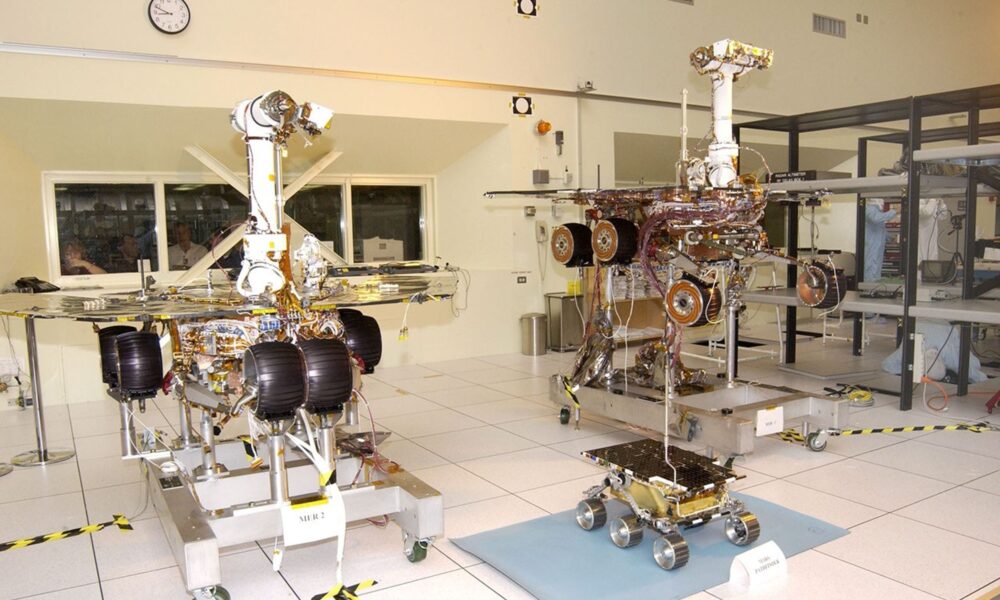
Look for photographs identified with a specific NASA/JPL image number and mission credit. NASA image PIA04422 is a real prelaunch cleanroom photograph of Spirit and Opportunity alongside the Sojourner flight spare. It is not a picture taken on Mars; it shows genuine flight hardware on Earth before launch.
For images actually captured on Mars, visit NASA’s Spirit and Opportunity photo archives and read each individual image caption. Many colored panoramas combine images obtained through different camera filters. A composite may be a scientifically valid representation without being a single-shot snapshot or an exact naked-eye color view.
One useful example is Opportunity’s self-portrait PIA07372, a mosaic assembled from images taken during December 2004. The rover’s own body and dusty Martian ground are visible, but the mast is missing because it held the camera.
Frequently asked questions
Is NASA’s Spirit rover still active in 2026?
No. NASA last heard from Spirit in March 2010 and ended its recovery effort in May 2011. It remains on Mars.
Is Opportunity still sending data?
No. Its final communication came on June 10, 2018 during a severe dust storm; the mission ended officially in February 2019.
Which rover launched first: Spirit or Opportunity?
Spirit launched on June 10, 2003. Opportunity launched July 7, 2003. Spirit also reached Mars first, on January 3, 2004.
Did either rover discover life?
No confirmed life was discovered. They found geological evidence that water once shaped parts of Mars, including past environments with different chemistry and potential habitability.
Is a NASA Mars Exploration Rover the same as Perseverance?
No. “Mars Exploration Rover” usually refers to the Spirit and Opportunity twin mission. Perseverance belongs to the newer Mars 2020 mission.
How far did Opportunity drive?
28.06 miles (45.16 km), according to NASA. The distance record fell to Perseverance on October 11, 2026.
Editorial review: October 15, 2026. Current-state and historic facts cross-checked against NASA Science, NASA/JPL mission records, and the NASA Photojournal. Distances and active-mission operations can change after this review date.

Other Articles