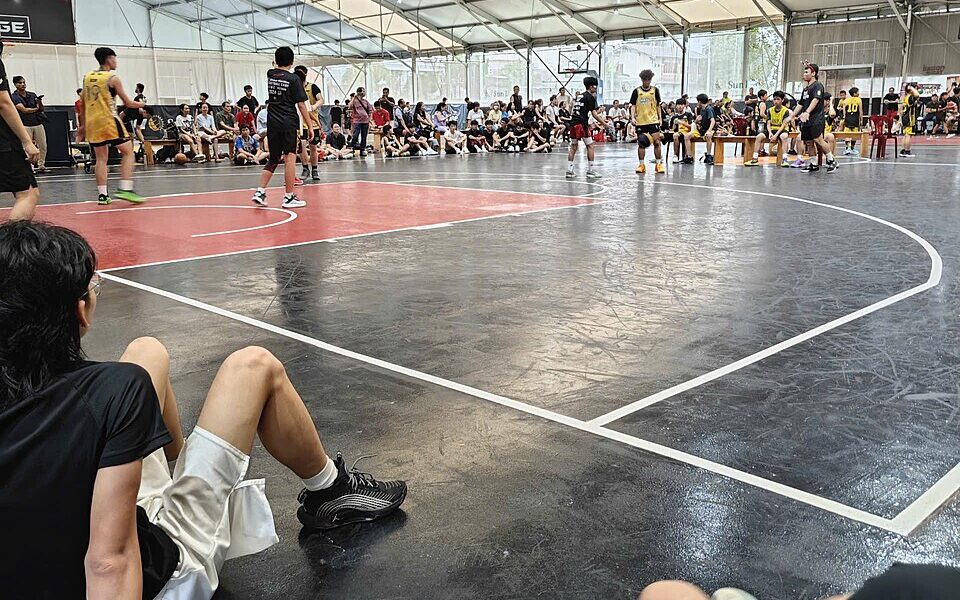

An NBA basketball court is 94 feet long and 50 feet wide (about 28.65 by 15.24 meters). A standard NCAA court is also 94 by 50 feet. A regulation FIBA playing court is 28 by 15 meters (about 91.9 by 49.2 feet), while U.S. high-school courts are often 84 by 50 feet, with 94-foot floors permitted or used where available. The critical distinction is that the width, length and painted markings are governed by the league or competition, not by one worldwide court template.
Basketball court size comparison
| Level | Playing-court length | Width | Main note |
|---|---|---|---|
| NBA | 94 ft (28.65 m) | 50 ft (15.24 m) | NBA three-point and painted-lane markings |
| NCAA college | 94 ft (28.65 m) | 50 ft (15.24 m) | Same outside rectangle; not the same three-point layout |
| U.S. high school (typical) | 84 ft (25.60 m) | 50 ft (15.24 m) | Verify local gym and governing-association rules |
| FIBA international | 28 m (91.86 ft) | 15 m (49.21 ft) | Metric dimensions measured within boundary lines |
These are the playing surfaces, not the building dimensions or safety runoff around the court. The FIBA Venue Guide requires a clear perimeter outside its 28-by-15-meter inner court; it describes an overall minimum 32-by-19-meter court area for compliant event planning.
NBA court dimensions and markings
The official 2025–26 NBA Officials Guide contains a court diagram with the 94-by-50-foot playing area. The hoop sits at each end and the two sides are divided by midcourt. NBA dimensions you may need when checking a diagram include:
- Length: 94 feet from baseline to baseline, measured on the playing floor.
- Width: 50 feet from sideline to sideline.
- Basket rim height: 10 feet from the floor.
- Three-point line: 23 feet 9 inches from basket center on the main arc, with shorter 22-foot corner distance.
- Paint / lane width: 16 feet.
A basketball court diagram often makes the three-point arc appear perfectly semicircular, but the NBA arc runs into straight segments near the corners. That is why a corner shot can be a three despite being physically closer to the hoop than a shot at the top of the arc.
FIBA court: 28 by 15 meters
FIBA uses a slightly shorter and narrower rectangle: 28 meters long and 15 meters wide. The court markings include a 6.75-meter main three-point arc and a 6.60-meter corner distance under the standard international layout. The official venue-design reference also specifies line widths and space surrounding the playing area, which is essential when constructing or marking a court.
Do not take NBA dimensions and merely convert feet to meters if you intend to create a FIBA-compliant floor. The perimeter, arc and restricted-area geometry differ.
How big is a high-school basketball court?
Many U.S. high-school gyms use an 84-by-50-foot court. Some facilities have a 94-by-50-foot layout and can host high-school games under applicable rules. Because older gyms, recreational facilities and local associations differ, the safe answer for a particular school is to check its measured lines and the relevant state association’s current rule book.
Do not assume that using an NBA-length court means a high-school game has NBA rules: clock durations, shot-clock adoption and certain markings may differ.
Basketball court area: how many square feet?
Multiply playing length by playing width. These calculations apply only to the rectangular playing surface, excluding stands, team benches and safety clearances:
| Floor | Calculation | Playing area |
|---|---|---|
| NBA / NCAA | 94 ft × 50 ft | 4,700 square feet |
| Typical 84-ft high-school court | 84 ft × 50 ft | 4,200 square feet |
| FIBA | 28 m × 15 m | 420 square meters |
Does a half court have a fixed size?
A regulation half court is half of the full playing floor. For an NBA-sized floor, it spans 47 by 50 feet. For a standard 84-foot high-school court, the rectangular half is 42 by 50 feet. Backyard courts and recreational half courts are frequently much smaller, with custom sidelines and safety spacing. Always ask whether the measurement describes the playable rectangle, the asphalt pad or the total construction footprint.
Basket, free-throw and three-point dimensions
Most standard adult leagues place the rim at 10 feet above the floor. The NBA free-throw line, paint and three-point arc are marked according to its own diagram. FIBA’s lines are not interchangeable with those of the NBA or NCAA, even when the rim height matches. A useful habit is to identify the governing organization before buying floor tape, planning court resurfacing or comparing shooting distances.
What to measure before building or repainting a court
- Confirm whether the intended use is NBA-style, NCAA, high-school, FIBA or recreational.
- Measure the inside of the intended boundary rectangle, not the wall-to-wall room size.
- Allow the competition-required out-of-bounds clearance for players and officials.
- Find the exact current court diagram for the competition before applying lane and arc measurements.
- Check overhead clearance, basket safety padding, accessible circulation and local venue requirements before construction.
Frequently asked questions
Is a basketball court always 94 feet long?
No. An NBA or NCAA court is 94 feet long; a common U.S. high-school court is 84 feet, and FIBA regulations specify 28 meters.
Are NBA and college courts identical?
The standard playing rectangle is the same 94 by 50 feet, but some painted markings and rules differ.
How wide is an NBA basketball court?
50 feet, approximately 15.24 meters.
Does the three-point line measure the same everywhere?
No. Three-point distances vary among NBA, FIBA, college and high-school play.
Read next: Our basketball positions guide explains how the five on-court roles use these areas.
Primary sources: NBA Officials Guide court diagram, 2025–26 and FIBA Venue Guide. Reviewed October 11, 2026.

Other Articles