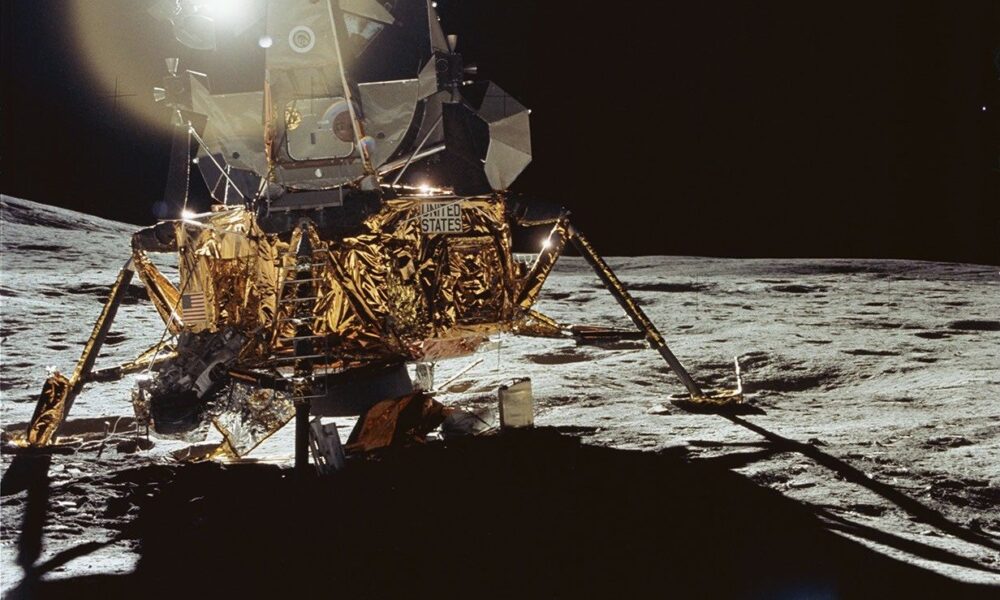

Quick answer: Apollo 14 landed Alan Shepard and Edgar Mitchell at Fra Mauro in February 1971 while Stuart Roosa orbited the Moon. Here is the mission timeline, science, rover-free surface work and the famous golf shot.

Overview
Apollo 14 landed Alan Shepard and Edgar Mitchell at Fra Mauro in February 1971 while Stuart Roosa orbited the Moon. Here is the mission timeline, science, rover-free surface work and the famous golf shot. The sections below answer the most common practical questions and distinguish stable fundamentals from details that may change over time.
Apollo 14 at a glance
Apollo 14 was NASA’s third successful crewed lunar landing and the first Apollo mission to land after Apollo 13’s aborted landing attempt. The Saturn V launched from Kennedy Space Center on January 31, 1971. The lunar module Antares landed on February 5, and the crew returned safely to Earth on February 9.
Who were the Apollo 14 astronauts?
Commander Alan B. Shepard Jr. and lunar module pilot Edgar D. Mitchell descended to the Moon. Command module pilot Stuart A. Roosa remained in lunar orbit aboard Kitty Hawk, supporting the surface mission and conducting observations. Shepard had previously become the first American in space in 1961, making Apollo 14 a remarkable return to flight.
Where did Apollo 14 land?
Antares touched down in the Fra Mauro highlands, a rugged region near the Moon’s equator. The site had been targeted for Apollo 13 before that mission was forced to return home. Scientists wanted material that could help reveal the history of a major ancient impact and the formation of the lunar crust.
What did astronauts do on the lunar surface?
Shepard and Mitchell completed two extravehicular activities, collecting rocks and soil and deploying scientific instruments. They used a wheeled handcart called the Modular Equipment Transporter to carry tools and samples. It was not the battery-powered Lunar Roving Vehicle introduced on Apollo 15.
What happened on the Cone Crater hike?
During the second moonwalk, the astronauts walked toward Cone Crater to collect material that might have been excavated from deeper layers. Difficult terrain and navigation uncertainty prevented them from confidently identifying the crater rim during the excursion. Later analysis of imagery and routes has helped researchers reconstruct how close they came.
How much lunar material did Apollo 14 bring back?
The crew returned approximately 42.8 kilograms, or about 94 pounds, of lunar rock and soil. These samples became important for understanding the Moon’s highlands and impact history. Scientists continue to study Apollo samples with techniques that did not exist during the original missions.
Did Alan Shepard really play golf on the Moon?
Yes. Near the end of a moonwalk, Shepard used a modified tool as a makeshift golf club and hit two golf balls. Low lunar gravity and the bulky spacesuit made the shots unlike ordinary golf on Earth. Claims about precise distances vary; the original mission footage is a better source than exaggerated online estimates.
How Apollo 14 differed from Apollo 13 and Apollo 15
Apollo 13 did not land because an oxygen-tank failure forced a return to Earth. Apollo 14 successfully reached Fra Mauro and conducted science on foot with a handcart. Apollo 15 later introduced a motorized lunar rover that enabled astronauts to travel much farther across the surface.
What happened to the spacecraft?
The Antares descent stage remained on the Moon after the astronauts lifted off in its ascent stage. Shepard and Mitchell reunited with Roosa in lunar orbit before heading home in the command module Kitty Hawk. The crew splashed down in the Pacific Ocean on February 9, 1971.
Why the mission still matters
Apollo 14 helped restore confidence after Apollo 13 and expanded the scientific collection of lunar highland samples. It also demonstrated that a mission could combine complex field geology, surface experiments and a safe return even after a major program setback.
Key takeaways
- Apollo 14 at a glance: Apollo 14 was NASA’s third successful crewed lunar landing and the first Apollo mission to land after Apollo 13’s aborted landing attempt.
- Who were the Apollo 14 astronauts?: Commander Alan B.
- Where did Apollo 14 land?: Antares touched down in the Fra Mauro highlands, a rugged region near the Moon’s equator.
- What did astronauts do on the lunar surface?: Shepard and Mitchell completed two extravehicular activities, collecting rocks and soil and deploying scientific instruments.
- What happened on the Cone Crater hike?: During the second moonwalk, the astronauts walked toward Cone Crater to collect material that might have been excavated from deeper layers.
- How much lunar material did Apollo 14 bring back?: The crew returned approximately 42.8 kilograms, or about 94 pounds, of lunar rock and soil.
Frequently asked questions
Was Apollo 14 the first Moon landing?
No. Apollo 11 made the first crewed Moon landing in July 1969; Apollo 14 was the third successful crewed lunar landing.
Did Apollo 14 use a lunar rover?
No. The crew used a hand-pulled equipment cart. The first motorized Apollo lunar rover flew on Apollo 15.
Who stayed in orbit during Apollo 14?
Stuart Roosa piloted the command module Kitty Hawk while Shepard and Mitchell explored the surface.
Related reading
Historical facts should be checked against NASA mission records and original Apollo photography.