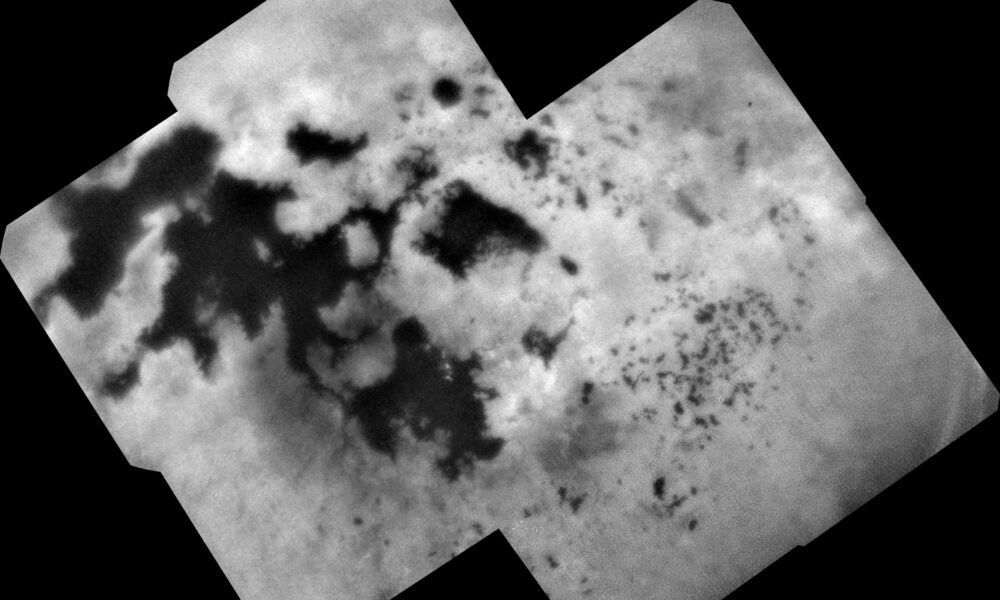

Titan is Saturn’s largest moon and the only moon in our solar system with a substantial, dense atmosphere. It is about 5,150 kilometers (3,200 miles) across—larger than the planet Mercury, although much less massive. Unlike Earth, Titan’s surface liquids are mainly methane and ethane, not liquid water. Cassini detected rivers, lakes, seas and weather systems beneath its thick orange haze. The pictures in this guide are real Cassini spacecraft observations of Titan, not artistic illustrations.
What makes Titan so compelling is the combination of an Earthlike weather cycle and extremely un-Earthlike chemistry. Methane evaporates, forms clouds, falls as rain and collects in low-lying terrain. A spacecraft called Huygens landed on Titan in January 2005, while NASA is developing the Dragonfly rotorcraft mission to explore its surface. Here’s what NASA actually knows and what remains uncertain.
Titan moon: essential facts
| Question | Answer |
|---|---|
| Planet it orbits | Saturn |
| Diameter | About 5,150 km (3,200 miles) |
| Atmosphere | Mostly nitrogen, with methane and other trace gases |
| Surface temperature | Roughly -179°C (-290°F) |
| Surface lakes and seas | Liquid methane and ethane |
| Orbital period | About 15.9 Earth days |
| Major missions | Cassini orbiter and ESA Huygens lander |
| Next planned mission | NASA Dragonfly |
These values are approximate. NASA’s Titan overview distinguishes Titan’s surface hydrocarbon lakes from the subsurface liquid-water ocean that scientists infer from other measurements. Neither should be described as a directly photographed ocean of liquid water on the surface.
What does Titan really look like?
In visible light Titan appears as a hazy orange sphere. The orange color comes from complex atmospheric chemistry driven by sunlight and charged particles, which produce organic aerosols. This thick haze hides much of the ground from ordinary cameras. Cassini therefore used radar and selected infrared wavelengths to map the surface and its northern seas.
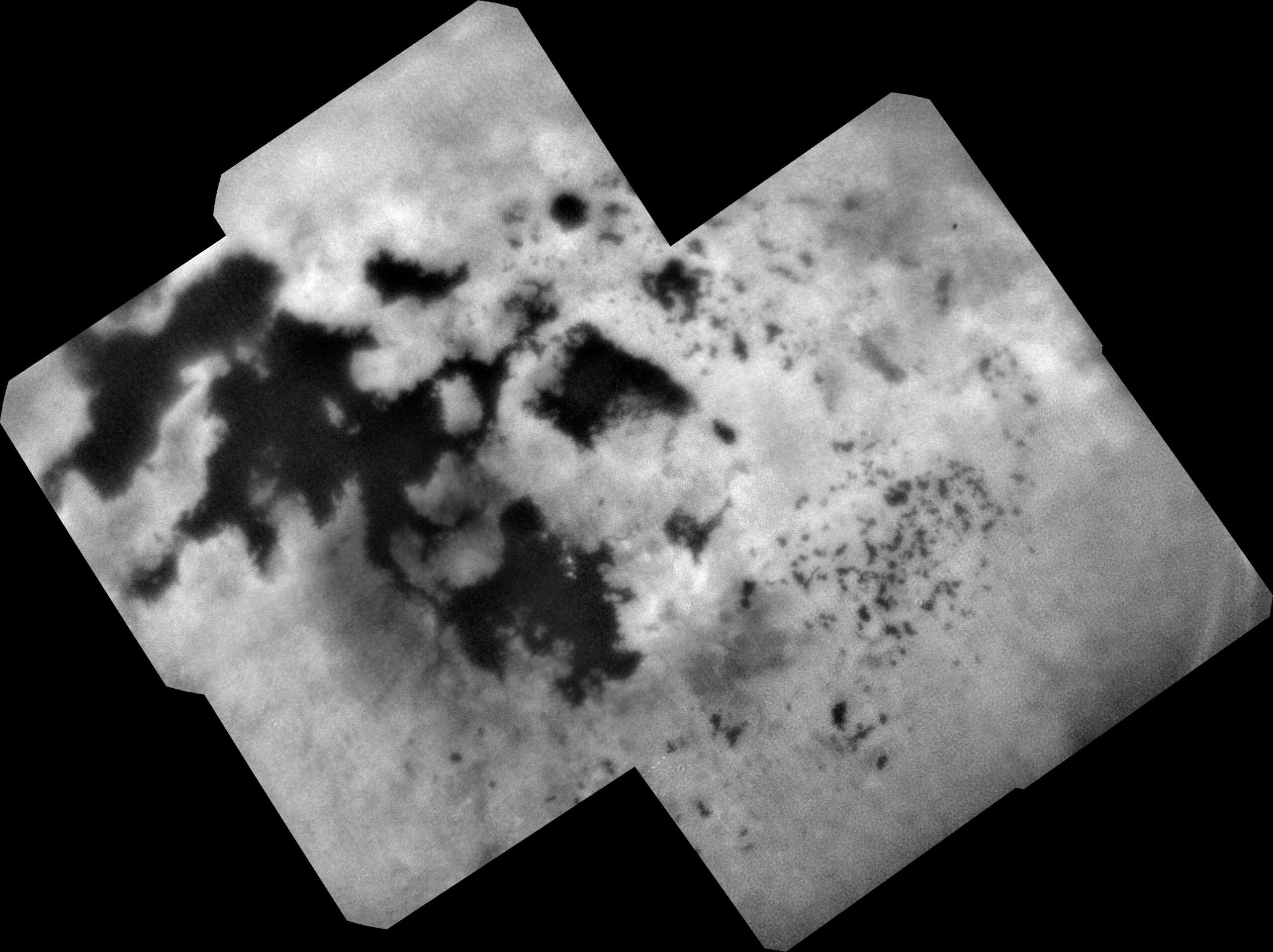
The photograph above is NASA Photojournal PIA22481, acquired during Cassini’s final distant encounter with Titan and released in 2018. It shows the north polar region, where many of Titan’s largest bodies of surface liquid are found. This is not a photograph of Earth’s coastline or an AI depiction of a methane sea.
Why does Titan have lakes and rivers of methane?
At Titan’s extremely low surface temperature, methane can exist as a liquid. Sunlight drives evaporation, clouds form in the atmosphere, and methane rain can replenish rivers and lakes. This is a methane-based hydrological cycle in analogy to Earth’s water cycle. Ethane and other hydrocarbons also accumulate in the lakes and seas.
Large northern seas have names such as Kraken Mare and Ligeia Mare. Cassini’s radar measured the shapes of coastlines and, in some cases, provided constraints on the depths and composition of the liquids. The radar image below is a separate observation from the spacecraft; blue colors were assigned to low radar backscatter to help readers identify dark lake regions. They are not the colors a human visitor would necessarily see.
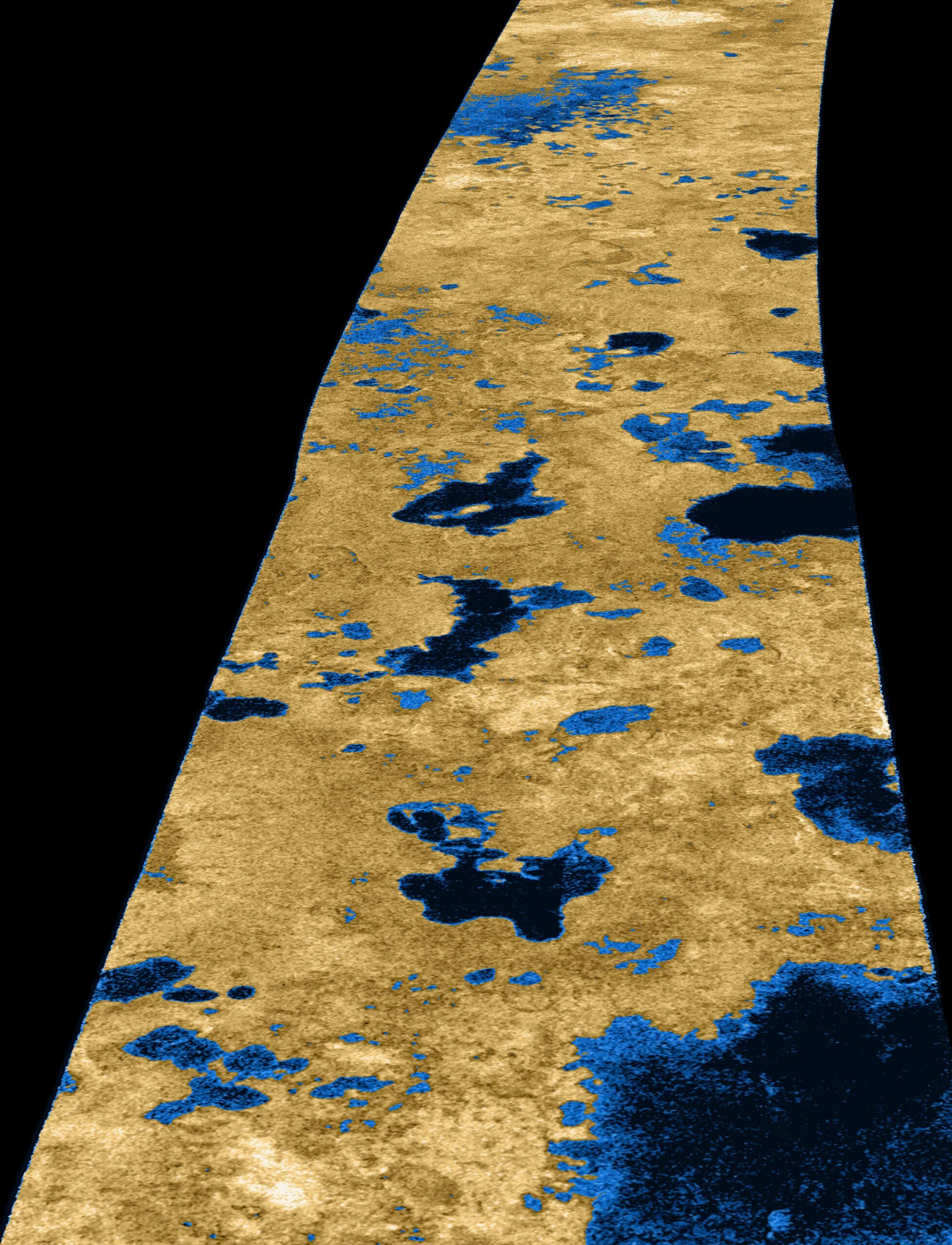
The original NASA radar record PIA09102 explains how the instrument detected the lakes through the atmosphere. Do not confuse this with a conventional color photograph; it is a genuine radar observation translated into a visual map.
Does Titan have an ocean of water?
Researchers have inferred that Titan likely contains a subsurface ocean of liquid water beneath its icy exterior. That hidden layer is distinct from the methane and ethane lakes on the surface. A subsurface ocean may be important to the moon’s internal structure and astrobiology, but no spacecraft has drilled down and sampled it directly.
Scientists also study complex carbon chemistry in Titan’s atmosphere and on its surface. Organic molecules are chemically interesting, but organic does not mean living. No confirmed life has been detected on Titan. Whether prebiotic reactions occur there and how they might work in such cold conditions are open scientific questions.
What happened when Huygens landed on Titan?
ESA’s Huygens probe separated from NASA’s Cassini spacecraft and descended through Titan’s atmosphere on January 14, 2005. It returned pictures and measurements during the descent and after landing on a cold surface with rounded ice-like pebbles and channels suggesting past fluid flow. The landing was a historic first for a probe on a moon in the outer solar system.
Huygens did not land in a large methane sea; it touched down on solid terrain. Its findings helped connect the radar evidence, atmospheric chemistry and landscape features. Read NASA’s Cassini mission history for the orbiter’s broader observations of Saturn and its moons, including Titan.
How is Titan different from Enceladus?
Both moons orbit Saturn, but they offer very different environments. Titan has a dense nitrogen atmosphere, methane rain and large surface hydrocarbon seas. Enceladus is much smaller and is known for water-rich plumes erupting from fractures near its south pole, providing samples of material associated with a subsurface ocean.
Our Enceladus moon explainer focuses on those icy geysers, while our Cassini mission guide explains how the spacecraft studied the entire Saturn system. The existence of an ocean beneath ice does not mean either moon has confirmed extraterrestrial life.
What will NASA’s Dragonfly mission do?
NASA’s Dragonfly is a planned rotorcraft mission designed to travel between sites on Titan, examine surface materials and investigate chemistry relevant to life’s building blocks. Titan’s thick atmosphere and low gravity make rotorcraft flight practical in ways very different from Earth. NASA currently lists launch no earlier than July 2028 and arrival at Titan in late 2034. On October 23, 2026, NASA reported that the Dragonfly team completed its most comprehensive simulated first-flight test to date using flight-like avionics; this was a ground simulation, not a flight on Titan.
Dragonfly is not a mission that has already landed. It will not automatically confirm life or fly over every Titan sea. For launch timing and science goals, check the official NASA Dragonfly mission page rather than relying on speculative social-media countdowns.
Could humans live on Titan?
Titan has fascinating resources for scientific study, but its surface is lethally cold, its atmosphere lacks breathable oxygen, and the surface liquids are hydrocarbons. Any human habitat would require extensive insulation, heating, power, life support and protection from environmental hazards. A thick atmosphere does not make Titan an easy second Earth.
Likewise, the fact that Titan is larger than Mercury does not make it a planet. It remains a natural satellite because it orbits Saturn. Its low density, icy materials and outer solar-system setting give it a distinct geological history.
Frequently asked questions
Is Titan bigger than Earth’s Moon?
Yes. Titan’s diameter is about 5,150 km, versus about 3,475 km for Earth’s Moon.
Is there liquid water on Titan’s surface?
Not stable exposed lakes of liquid water. Its surface lakes are mostly methane and ethane; liquid water is inferred deeper below the icy crust.
Is Titan’s orange color real?
Yes. Its haze appears orange in visible light, although many surface maps use assigned radar or infrared colors.
Did Cassini land on Titan?
Cassini orbited Saturn and flew past Titan; the separate Huygens probe landed there in 2005.
Is there life on Titan?
No confirmed life has been detected. Its chemistry makes it an important research target.
What are Titan’s seas made of?
Liquid hydrocarbons, especially methane and ethane, not salty liquid water like Earth’s oceans.
Primary sources and image credits
Key physical facts come from NASA’s Titan overview. Both images are genuine Cassini observations locally uploaded to AVARIXO: PIA22481, NASA/JPL-Caltech/Space Science Institute, and PIA09102, NASA/JPL-Caltech/USGS. Their distinct source records and license/credit notes are retained in Media Library. Neither image is an invented landscape, and no NASA endorsement is implied.

Other Articles

Warfare Tycoon Codes (October 2026): Cash Rewards and Redeem Guide