
The Helix Nebula is the glowing shell of gas expelled by a dying Sun-like star, located roughly 650–700 light-years from Earth in Aquarius. Its catalog names are NGC 7293 and Caldwell 63. The bright ring and faint outer structures are a planetary nebula, not a planet and not a separate galaxy. A hot white dwarf near the center is the exposed stellar core that remains after the original star shed its outer layers.
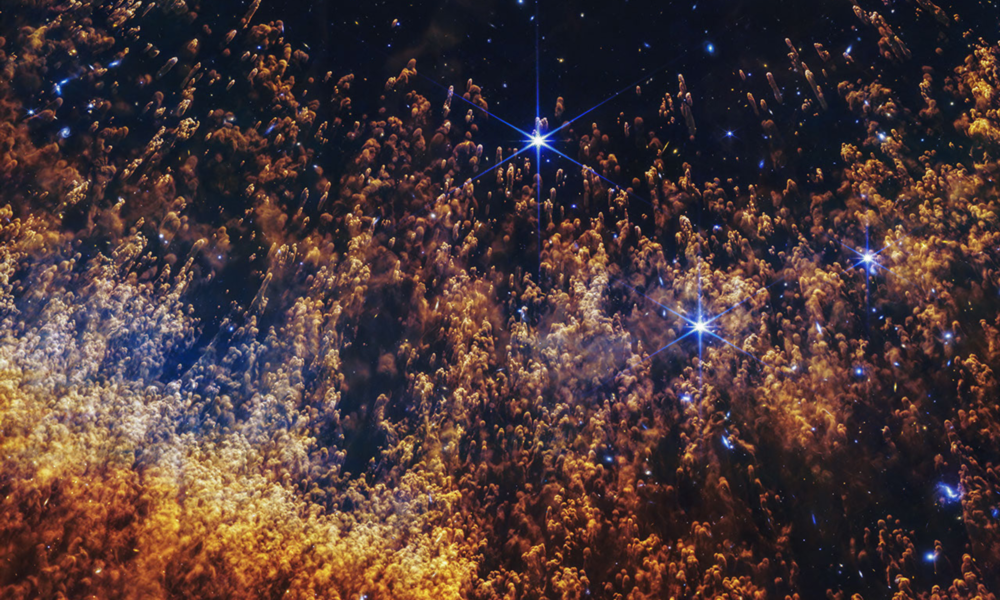
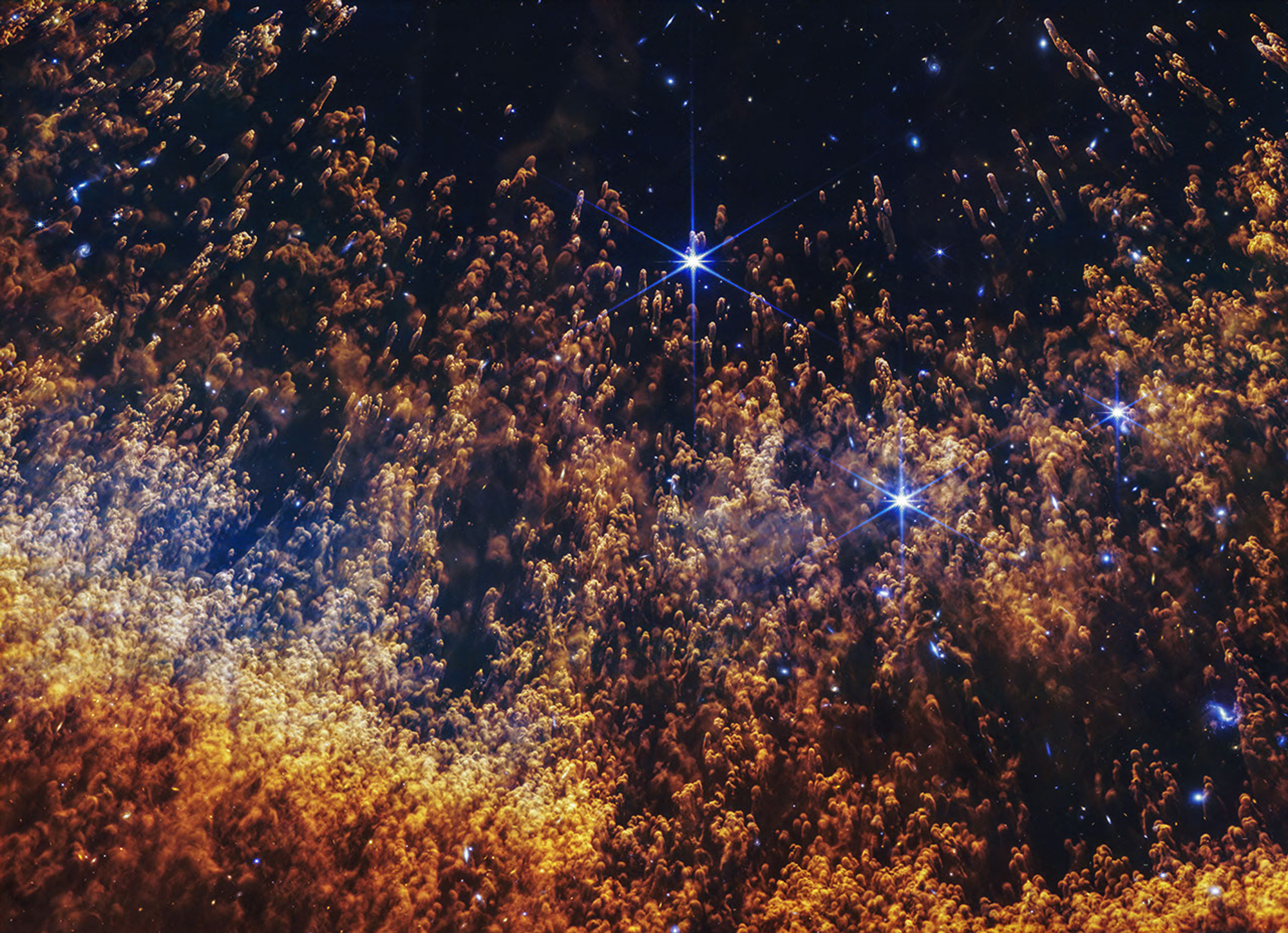
NASA released a striking James Webb Space Telescope close-up in January 2026, showing thousands of comet-like gas knots along the nebula’s inner edge. The featured image below is the real Webb NIRCam observation; the second image is a distinct Hubble-plus-ground-telescope view of the entire nebula. Comparing them answers a practical question: why does the Helix look like a giant blue eye in one picture and a field of golden fingers in another?
Helix Nebula facts at a glance
| Question | Answer |
|---|---|
| Scientific designation | NGC 7293 / Caldwell 63 |
| Constellation | Aquarius |
| Distance | About 650 light-years in NASA’s recent Webb and Caldwell references; older Hubble descriptions give around 690 |
| Object type | Planetary nebula |
| What powers the glow? | Radiation from a hot central white dwarf ionizes ejected gas |
| Bright ring width | Nearly 3 light-years, with fainter structures beyond |
| Apparent magnitude | About 7.3 in NASA’s Caldwell catalog |
| Webb observation | NIRCam exposure on October 24, 2024, publicly released January 20, 2026 |
| Famous nickname | Eye of God (popular nickname, not a scientific designation) |
The distance and magnitude figures follow NASA’s Caldwell 63 profile and 2026 Webb image record. Different research methods and rounding can produce slightly different estimates. Do not treat an approximate 650-light-year value as a measurement exact to the last light-year.
What exactly is a planetary nebula?
Despite the name, a planetary nebula has nothing to do with planets. Early astronomers used the term because some of these objects looked like small, round planetary disks in telescopes. In reality, it is a relatively brief late stage in the evolution of a low- or intermediate-mass star. The star expands into a red giant and loses its outer gas. The hot exposed core emits energetic ultraviolet radiation that causes the surrounding gas to glow.
Eventually the outer gas disperses and the remaining stellar core cools as a white dwarf. Our Sun is expected to undergo a broadly similar late-life transformation, but that does not mean the Sun will form a nebula identical in shape or size to the Helix. The exact mass, stellar history, companion stars and surrounding material all affect the outcome.
Why does the Helix Nebula look like an eye?
From Earth, the bright inner gas and dust resemble a colorful iris surrounding a central blue region. The apparent ring is not a flat circle painted onto space. Observations show an intricate three-dimensional distribution of shells, disks and knots viewed from a particular direction. NASA’s 2004 Hubble analysis found evidence for two gaseous disk-like structures at different orientations; one proposed explanation involved a companion star, but the geometry remains an interpretation of complex observations.
That shape also explains the nickname “Eye of God.” It is a popular visual analogy, not an official astronomy name and not evidence of an eye-shaped object looking at Earth. The nebula is a physical cloud of matter illuminated by a dying star’s remnant.
What did James Webb discover in the 2026 image?
Webb’s NIRCam instrument focused on only a small section of the Helix, about one light-year across, rather than the entire ring. The image reveals thousands of small pillars with rounded heads and elongated tails. They look like comets, but they are not icy comets orbiting the Sun. They are dense gas-and-dust structures being shaped by fast-moving hot gas and the older, cooler material expelled by the central star.
The data were captured on October 24, 2024 and released publicly on January 20, 2026. NASA describes the image as an unusually detailed look at how material expelled by an aging star interacts with its environment. The date of publication should not be confused with the exposure date; this is not a live 2026 camera feed from space.
Why do the Webb knots look orange and gold?
Webb observes infrared wavelengths invisible to human eyes. Scientists assign visible colors to different NIRCam filters to make the observations understandable. For the 2026 Helix image, NASA maps the shortest selected filters to blue, intermediate filters to green, and longer ones to red. Combining those channels produces golden, rust-colored and blue regions. The mapping is grounded in genuine measurements, but a human floating nearby would not see precisely the same saturated colors.
The darker red or orange knots highlight structures in the gas and dust, not glowing molten rock. Webb’s NIRCam reveals details that earlier optical photographs could not isolate so sharply. This is one reason comparing different instruments is more informative than treating every published color photo as an identical representation of the same wavelengths.
How does the 2004 Hubble image compare?
The second image is an authentic composite of Hubble Space Telescope Advanced Camera for Surveys observations from November 2002 and Cerro Tololo Inter-American Observatory images from September 2003, released by NASA in December 2004. Hubble supplied detailed inner structures; the ground-based telescope helped capture the full broad nebula that did not fit within Hubble’s field of view.
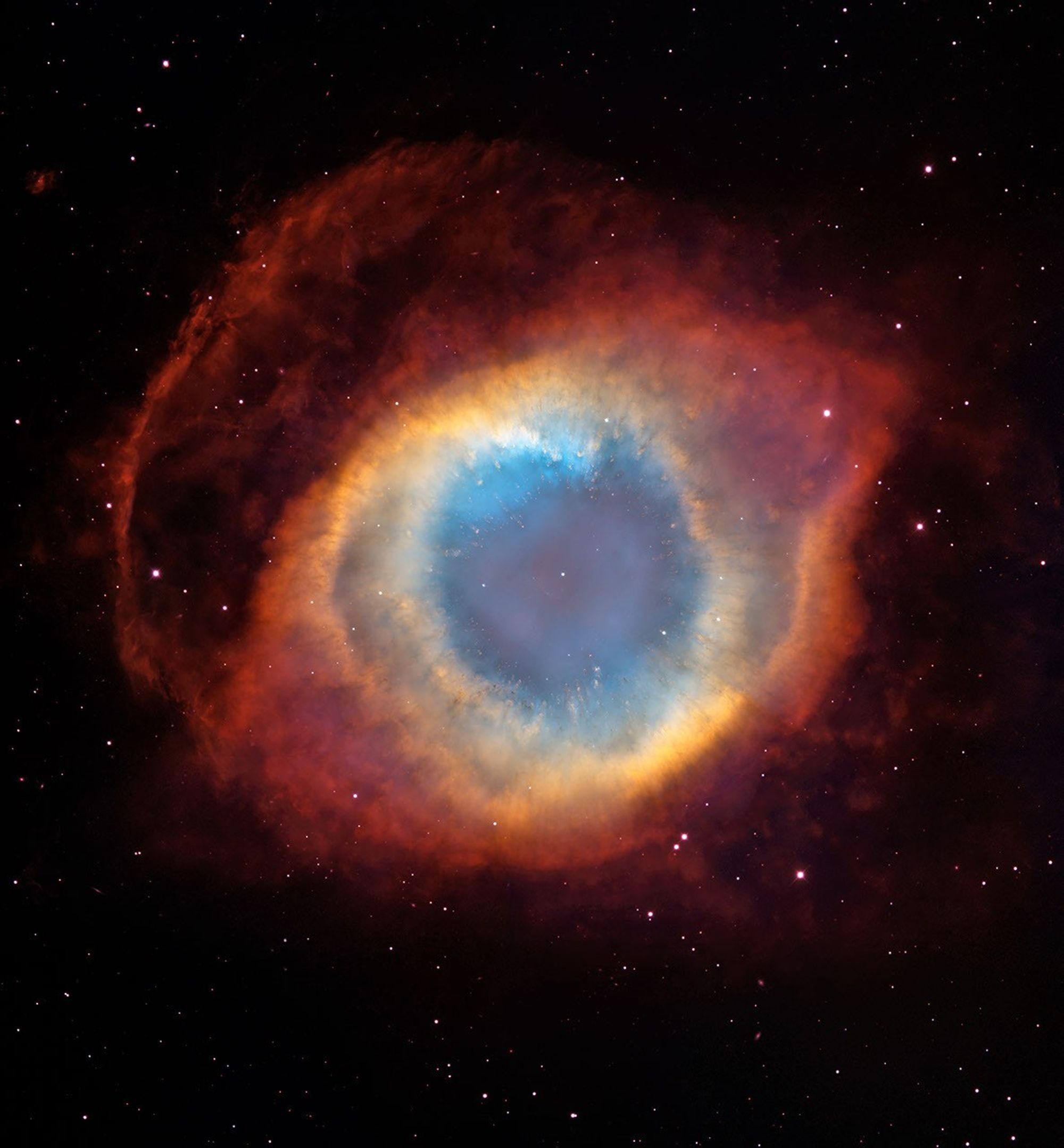
In this wider image, the bright ring looks like a luminous eye surrounded by a red halo. The Webb image instead zooms into the fine structure of a smaller part of the ring. They do not disagree about the nebula’s appearance: they sample different spatial scales and wavelengths. NASA’s original Hubble science record documents the observing dates, equipment and image processing.
How far away is the Helix Nebula?
NASA’s recent public Webb and Caldwell pages use 650 light-years. Some older Hubble documentation uses about 690 light-years, and the European Southern Observatory quotes around 700 light-years. These are approximate astronomical distances, not conflicting claims that the nebula moved tens of light-years within a few decades.
A light-year is the distance light travels in one year, about 9.46 trillion kilometers. The Helix is relatively close for a nebula, which helps astronomers resolve fine gas structures that would be impossible to see in a similar object thousands of times farther away. A recent 2026 research paper uses an astrometric estimate of about 198.6 parsecs, equivalent to roughly 648 light-years, for the central white dwarf.
How big is the Helix Nebula?
NASA’s Caldwell catalog says the bright ring stretches across nearly three light-years, with faint outer features extending farther. The 2004 Hubble-plus-ground mosaic covers a wider region, while the 2026 Webb close-up spans about one light-year. A field-of-view measurement for a telescope image should never be mistaken for the full diameter of the object.
Although the nebula appears compact in an image, even a one-light-year patch is roughly 9.46 trillion kilometers across. Its gas is very tenuous compared with Earth’s atmosphere, so the giant columns are not solid walls or rocky structures.
Is the Helix Nebula a dying star or a supernova remnant?
It is the former. A planetary nebula forms when a Sun-like star loses its outer layers; it does not require the violent core-collapse supernova that produces many neutron stars. The central star in the Helix is a white dwarf, not a pulsar. That distinction separates it from the Crab Nebula, which is debris from the supernova recorded in 1054 CE and contains a fast-spinning neutron star.
Another comparison is the Ring Nebula (M57), a different planetary nebula. Both feature material expelled late in stellar evolution, but their geometry, distance and central-star environments differ.
Can you see the Helix Nebula with a backyard telescope?
Yes, under suitable dark skies, but its large apparent size and low surface brightness make it tricky. The Helix lies in Aquarius, not Orion. NASA lists an integrated magnitude of around 7.3, yet the light is spread across a broad area. A faint, extended nebula can be harder to see than a point-like star of the same integrated magnitude.
The Astronomical League recommends dark, moonless skies, observing when the nebula is well above the horizon, and using an O III or UHC nebula filter to improve contrast. Binoculars or low-power wide-field telescopes can sometimes reveal the large, diffuse patch more effectively than high magnification. For many northern observers, autumn evenings are a useful observing season; the best time depends on latitude and local sky conditions.
How to photograph the Helix Nebula
- Find Aquarius on a current sky chart. Locate the Helix’s catalog designation NGC 7293 rather than relying on the popular “Eye of God” nickname.
- Choose a dark location and a wide enough field. Its large apparent diameter makes very narrow camera framing a common mistake.
- Use a tracking mount and several exposures. The low surface brightness of the outer shell benefits from stable tracking and sufficient integration time.
- Consider appropriate narrowband filters. Oxygen and hydrogen emission can help reveal different structures, but filter choice depends on camera and sky conditions.
- Record how colors were processed. If combining filtered exposures, explain the color mapping rather than presenting the result as an unaided-eye view.
Helix Nebula frequently asked questions
Is the Helix Nebula a galaxy?
No. It is a planetary nebula inside our Milky Way, not an independent galaxy.
What is at the center of the Helix Nebula?
A hot white dwarf, the compact exposed core of the original Sun-like star.
Did Webb photograph the entire nebula in 2026?
No. Webb’s image shows a small, highly detailed section. The data were collected in October 2024 and released in January 2026.
Is the Eye of God its official name?
No. It is a popular nickname; NGC 7293 and Caldwell 63 are catalog designations.
Are the comet-shaped objects real comets?
No. They are dense gas and dust knots shaped by interactions with stellar winds and radiation.
Can you see the nebula without a telescope?
Its low surface brightness makes naked-eye detection impractical for most observers. Binoculars or telescopes under very dark skies are more useful.
Will our Sun become a planetary nebula?
Our Sun is expected to expand into a red giant and shed outer layers late in its life, but the eventual appearance depends on stellar evolution and surrounding conditions.
Image rights and primary sources
The two original observational images are locally hosted in AVARIXO’s WordPress Media Library with individual alt text and credited source metadata. The featured image comes from NASA’s 2026 Webb NIRCam release (NASA/ESA/CSA/STScI; Alyssa Pagan); the second from NASA’s 2004 Hubble and Cerro Tololo mosaic (NASA/ESA; C.R. O’Dell, M. Meixner, P. McCullough). The NASA Caldwell profile supports the distance, type and observing context, and the Astronomical League’s observing guide supports the telescope advice. These are actual telescope data products, not AI-generated substitutes. Their use does not imply NASA or ESA endorsement.