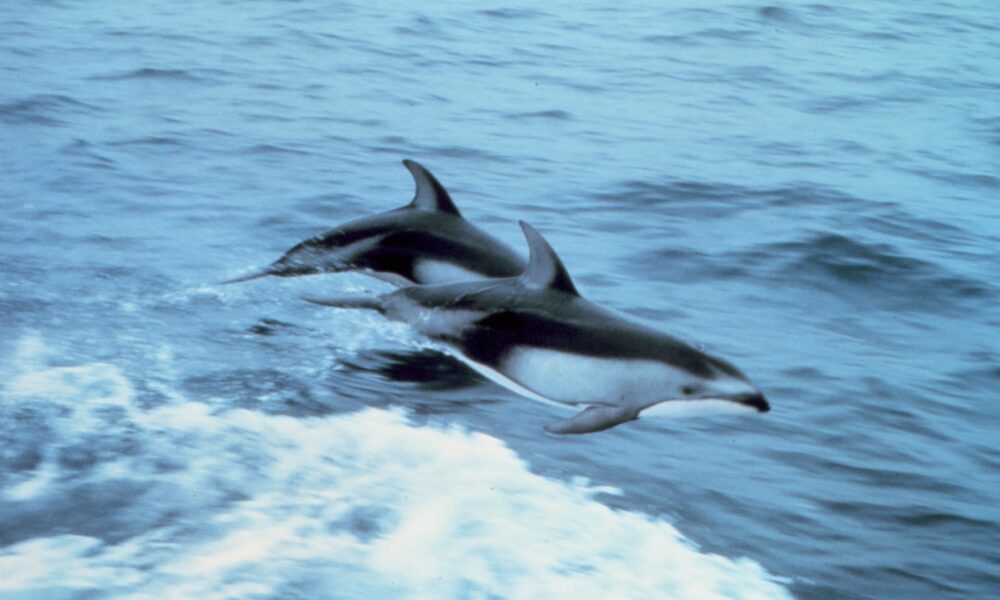

Quick answer: The Pacific white-sided dolphin (Lagenorhynchus obliquidens) is a swift, social dolphin of the temperate North Pacific Ocean. It has a sharply curved dorsal fin, a dark back, lighter gray-and-white side patches and a relatively short beak. NOAA Fisheries reports that adults usually measure about 5.5–8 feet and weigh roughly 300–400 pounds. These dolphins often travel in groups, hunt schooling fish and squid, and may leap from the water—but their patterned flanks can make them easy to confuse with other dolphins.
Pacific white-sided dolphin: basic facts
| Fact | Details |
|---|---|
| Scientific name | Lagenorhynchus obliquidens |
| Animal group | Marine mammal; oceanic dolphin family |
| Typical length | Approximately 5.5–8 feet |
| Typical adult weight | Approximately 300–400 pounds |
| Habitat | Temperate North Pacific, both open-ocean and continental margin waters |
| Diet | Schooling fish and squid |
| Life span | Can exceed 40 years |
| Main human-related threats | Fishing gear entanglement, noise and habitat disturbances |
| Protection in U.S. waters | Marine Mammal Protection Act |
Measurements, distribution and feeding behavior follow NOAA Fisheries’ official species science profile.
How do you identify a Pacific white-sided dolphin?
Look for a mostly dark gray-to-black upper body with light gray bands and white patches along the flanks. A tall, sickle-shaped dorsal fin is another clue. The lighter marking can stretch from the front of the body toward the tail, giving a strongly contrasting appearance when the animal swims near the surface.
Young animals are often lighter, and surface photographs may show only a fraction of the side pattern. Identification requires several clues; a dorsal fin by itself is not enough because common dolphins, Atlantic white-sided dolphins and Dall’s porpoises can have confusingly similar shapes in poor visibility.
Pacific white-sided dolphins versus Dall’s porpoises
| Trait | Pacific white-sided dolphin | Dall’s porpoise |
|---|---|---|
| Beak | Short, but discernible | Very short, blunt appearance |
| Flank markings | Complex light gray and white patches | Striking bright white side patch on dark body |
| Swimming pattern | Often leaps and bow-rides | Fast, can create characteristic “rooster-tail” spray |
| Grouping | Commonly social with other dolphins | Variable, often small groups |
Taxonomic distinctions cannot always be determined from one photo; professional observers also consider location, school behavior and multiple body views.
Where do Pacific white-sided dolphins live?
Their natural range covers cooler temperate North Pacific waters, from the eastern coast of Asia across to the northeastern Pacific. They occur in the waters off California, Oregon, Washington and Alaska and in regions of Japan and Russia. NOAA describes them as common in continental-shelf and slope habitat as well as offshore waters.
Do they migrate along the U.S. West Coast?
Surveys indicate seasonal movements, with animals appearing more often off California in colder months and shifting northward toward Oregon and Washington as conditions change. It is not a simple guaranteed migration calendar, however; distribution varies with prey availability and ocean conditions. Stock boundaries in this wide-ranging species remain an area of scientific research.
What do they eat?
Pacific white-sided dolphins hunt squid and fish including anchovies, sardines, herring and other schooling species. They may feed cooperatively, gathering prey in groups. Their conical teeth grip slippery fish rather than chewing food into small pieces. NOAA reports that some individuals can remain below the surface for more than six minutes while foraging, but that ability should not be presented as the normal length of every dive.
How do they find prey?
As toothed cetaceans, these dolphins use echolocation clicks to interpret echoes returning from prey or objects underwater. They also rely on vision, hearing and social coordination. Echolocation helps when conditions are murky or dark, but it does not make the dolphin capable of detecting every underwater hazard in advance.
Do they swim with other dolphin species?
Mixed-species groups have been observed in Pacific habitats, including associations with northern right whale dolphins and other cetaceans. Group size may range from a few animals to much larger aggregations. A spectacular video of hundreds together should not be treated as the normal daily experience of every individual dolphin.
How do these dolphins reproduce?
Females carry calves for roughly nine to twelve months. NOAA describes calves born at around three to four feet and about thirty pounds. Mothers nurse calves for many months, while mature individuals can live for decades. Reproduction and population trends differ between study areas, so simple internet estimates cannot substitute for stock assessments.
Are Pacific white-sided dolphins endangered?
The species is generally not described as globally endangered, but local stocks still face risks. NOAA manages populations under the Marine Mammal Protection Act and periodically publishes stock assessments. Incidental capture in fishing gear, vessel traffic and ocean noise can affect them, while prey changes may influence seasonal distribution.
NOAA’s U.S. Pacific marine mammal stock assessments provide detailed regional analysis. Avoid presenting one U.S. stock number as the global population.
How to observe them responsibly
- Watch from shore or use an operator who follows marine-mammal viewing guidelines.
- Keep a respectful distance—NOAA generally recommends at least 50 yards from dolphins in U.S. waters unless stricter rules apply.
- Do not swim toward, chase or feed any dolphins.
- Do not use the boat to split groups or block their path.
- Allow animals to move away without being followed.
- Report injured animals to authorized marine-mammal responders rather than attempting handling.
These rules help keep wild behaviors natural. For a very different type of sea animal, read AVARIXO’s published deep-sea jellyfish identification guide, which explains how gelatinous invertebrates differ from marine mammals.
Frequently asked questions
How big are Pacific white-sided dolphins?
NOAA lists typical adult lengths of approximately 5.5–8 feet and weights around 300–400 pounds.
Are they found in the Atlantic Ocean?
No. Their native range is the North Pacific. Similar-looking Atlantic white-sided dolphins are a different species.
What do their white markings look like?
They have contrasting pale gray and white patches along the sides of the body, combined with darker upper surfaces.
Do they eat fish or plants?
They are predators that mainly eat fish and squid.
Do they jump out of the water?
Yes, leaping and energetic surface activity are commonly observed, but individuals are not necessarily visible above the surface every time.
Fact-checked October 2026 using NOAA species science and regional stock assessments.