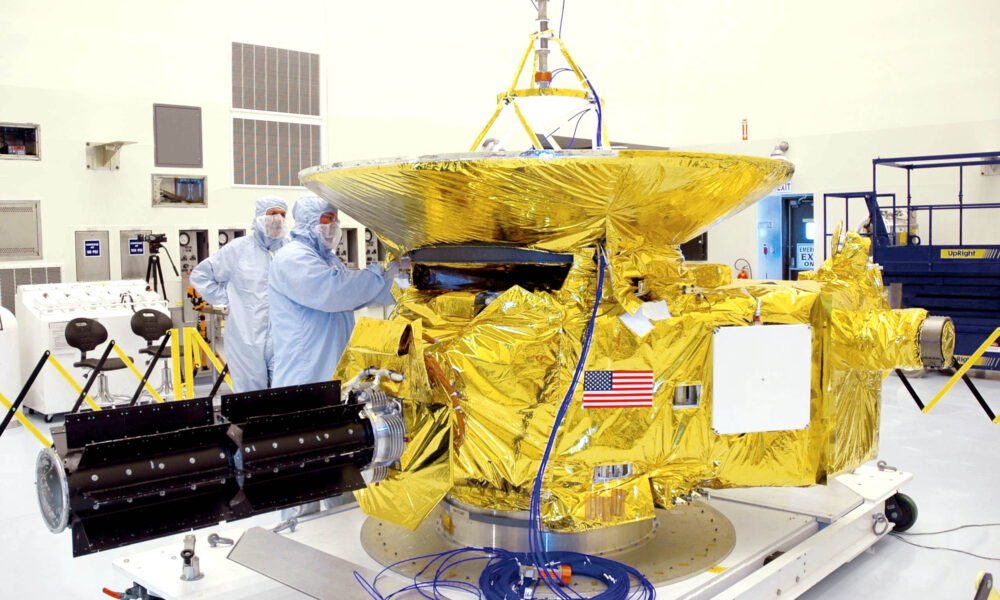

Quick answer: NASA’s New Horizons is a robotic spacecraft launched in January 2006 to explore Pluto and the distant Kuiper Belt. It made its historic Pluto flyby in July 2015 and later flew past the small Kuiper Belt object Arrokoth on January 1, 2019.

Why Pluto was a major target
Before the flyby, even large telescopes could not resolve many details of Pluto’s surface. New Horizons revealed mountains of water ice, vast nitrogen-ice plains and a thin atmosphere with layered hazes.
How a flyby differs from an orbiter
New Horizons traveled past Pluto rather than slowing into orbit. It gathered observations rapidly during the encounter, stored data and transmitted the results back to Earth over a much longer period.
What the spacecraft discovered at Arrokoth
Arrokoth is a contact binary made of two joined lobes. Its shape and relatively undisturbed condition offer clues about how small icy bodies formed in the early solar system.
How the spacecraft communicates from so far away
New Horizons uses a high-gain radio antenna and NASA’s Deep Space Network. Data rates are limited at extreme distances, so a short encounter can require many months to return its stored science data.
Why a gravity assist at Jupiter mattered
The 2007 Jupiter flyby increased the spacecraft’s speed and allowed additional observations of Jupiter’s atmosphere, moons and magnetic environment.
How to avoid mixing up the name
The space mission is unrelated to Nintendo’s Animal Crossing: New Horizons. Search for ‘NASA New Horizons spacecraft’ when looking for science information rather than game walkthroughs.
At a glance: what to remember
- Why Pluto was a major target: Before the flyby, even large telescopes could not resolve many details of Pluto’s surface.
- How a flyby differs from an orbiter: New Horizons traveled past Pluto rather than slowing into orbit.
- What the spacecraft discovered at Arrokoth: Arrokoth is a contact binary made of two joined lobes.
- How the spacecraft communicates from so far away: New Horizons uses a high-gain radio antenna and NASA’s Deep Space Network.
Frequently asked questions
Did New Horizons land on Pluto?
No. It performed a high-speed flyby.
Is Pluto a planet again?
Pluto remains classified as a dwarf planet by the International Astronomical Union; the spacecraft’s discoveries do not automatically change that classification.
Bottom line
NASA’s New Horizons is a robotic spacecraft launched in January 2006 to explore Pluto and the distant Kuiper Belt. It made its historic Pluto flyby in July 2015 and later flew past the small Kuiper Belt object Arrokoth on January 1, 2019. For mission milestones and updated findings, refer to the original space agency rather than treating an old timeline as a current announcement.
Primary source: NASA official mission and science documentation.

Other Articles

Apollo 11 Mission Explained: Timeline, Crew, Moon Landing and Return
