
Quick answer — fact-checked October 15, 2026: The Butterfly Nebula is NGC 6302, a dramatic planetary nebula in the constellation Scorpius. It is also known as the Bug Nebula or Caldwell 69. The bright butterfly-shaped wings are not a creature or a newly forming galaxy. They are the vast, hot outer layers expelled by a star nearing the end of its life. NASA places the nebula roughly 2,500–3,800 light-years away in different published analyses, and its two-lobed structure stretches across approximately two light-years.
The especially famous Hubble photograph is a real July 27, 2009 telescope observation. Hubble examined NGC 6302 again in observations from 2019–2020, revealing further details of the gas and possible past outflows. The camera records actual light from the nebula, but the eye-catching colors are assigned to different wavelength filters. This guide explains what the Hubble images reveal, why the center looks dark, what the extreme temperatures mean, and how to identify the same object under its other names.
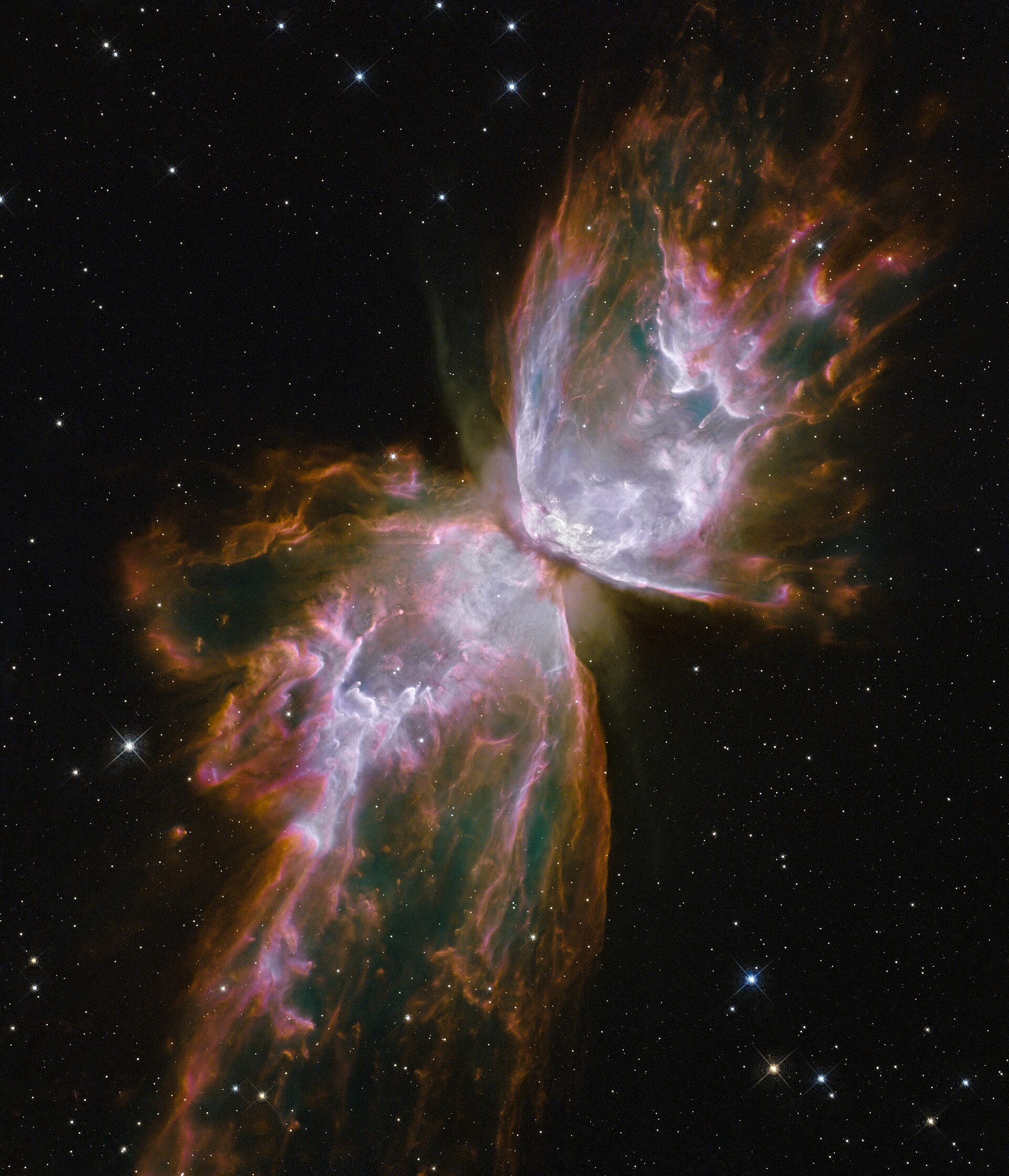
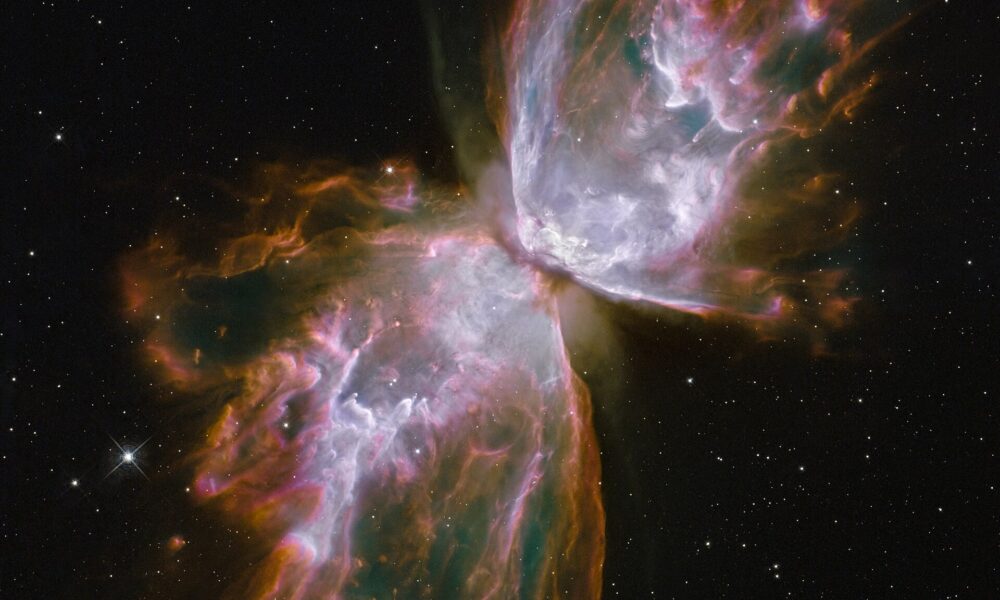
Understanding the image: This NASA/ESA Hubble image was acquired in 2009 using multiple filtered exposures. It depicts the actual NGC 6302 nebula, not a digital illustration and not a 2026 live image. Colors are derived from scientific filter data, not guaranteed to match the unaided-eye view.
What is the Butterfly Nebula?
The Butterfly Nebula is a bipolar planetary nebula: an expanding cloud of material released as a star evolves toward a very compact, hot remnant. The name “planetary” is a historical misnomer dating to early telescopes, when many small, rounded nebulae appeared planet-like. NGC 6302 is not a planet, an orbiting collection of butterflies, or a planet-forming disk.
Its gas shines because radiation from an extremely hot central star ionizes the ejected material. In a simplified picture, atoms lose electrons under energetic ultraviolet light and produce characteristic spectral lines as particles recombine or change energy levels. Astronomers can isolate these emission wavelengths through filters to map where various ions are present.
The enormous wings are better thought of as two opposing expanding lobes than a flat silhouette. We see a three-dimensional shape projected onto a two-dimensional image. The dark-looking waist between the lobes plays an essential role in explaining why the star’s outflow expanded far more in some directions than others.
Butterfly Nebula facts at a glance
| Feature | Supported detail | Important qualification |
|---|---|---|
| Catalog name | NGC 6302 | Also called Butterfly Nebula, Bug Nebula, Caldwell 69 |
| Astronomical type | Bipolar planetary nebula | Gas from an evolved star, not a forming planetary system |
| Location | Scorpius, in the Milky Way | Southern portion of the zodiac constellation |
| Approximate distance | 2,500–3,800 light-years | Different studies and NASA pages give different estimates |
| Physical extent | Over two light-years across | Depends on which faint gas is included |
| Wing gas temperature | More than 36,000°F in NASA’s description | Temperature varies across the nebula |
| Gas motion | Over 600,000 mph in fast regions | Does not mean every parcel moves at the same speed |
| Famous Hubble image | July 27, 2009, WFC3 | Released September 2009 |
| Additional Hubble imaging | 2019–2020 WFC3 observations | Published June 2020 |
| Central source | Very hot star concealed by central dust | Not identified as a black hole |
The distance range above reflects NASA’s 2020 Hubble summary (2,500–3,800 light-years), rather than presenting a single uncertain figure as an exact distance. An older NASA release uses approximately 3,800 light-years. These figures are estimates of the same astronomical object.
Why does NGC 6302 look like a butterfly?
Its appearance begins with a striking dusty torus or donut-shaped belt around the central star. This denser equatorial material restricts some of the escaping gas, while gas can expand more freely above and below the belt. From our perspective, the two long lobes resemble butterfly wings pinched together at the middle.
First, an aging star loses its outer layers
The star evolved through a giant phase in which its outer envelope became extended and much of it was lost to space. NASA’s 2009 description presents a scenario in which slower gas was first deposited around the star’s equatorial region. Other expelled gas moved away along directions closer to the star’s poles, producing the broad, two-sided shape.
Then faster winds change the shape of the gas
As the central remnant grew hotter, it launched fast, energetic outflows into previously ejected material. The interaction can create shocks, compressed shells and irregular fingers in the wings. NASA’s original analysis mentions stellar winds exceeding two million miles per hour interacting with slower gas. That is a model of different epochs and components—not a license to claim every part of the nebula moves at exactly one speed.
The wings are full of filaments, not smooth fabric
High-resolution Hubble data show bright edges, thin filaments, clumps and uneven illumination. Some small inward-pointing projections could be denser material that resisted a fast stellar wind longer than its surroundings. Researchers compare patterns like these to understand how mass-loss episodes and changing radiation conditions shaped the nebula.
What is inside the dark center?
One persistent internet misconception is that the dark waist is a black hole, a mysterious eye or a literal gap in space. NASA instead identifies a thick ring of dust surrounding the central source. The star is extremely hot, but it is difficult to see in conventional visible-light views because the dust blocks the line of sight and the star emits strongly at ultraviolet wavelengths.
NASA has described the star as one of the hottest known central stars in planetary nebulae, with a surface temperature of several hundred thousand degrees Fahrenheit. Such a temperature does not automatically make it a supernova or an active black hole. Its high-energy radiation is important because it powers much of the glow in surrounding gas.
Is the butterfly’s “body” a black hole?
No evidence in the famous Hubble photograph demonstrates a black hole. Dark material and high contrast cannot establish one. The physically grounded explanation involves dust obscuration, geometry and an evolved stellar source.
Can infrared light show more behind the dust?
Infrared observations can reveal regions and emissions less prominent in visible light. The 2019–2020 Hubble observing campaign combined near-ultraviolet through near-infrared information, and its team highlighted an S-shaped pattern from singly ionized iron. This signal may trace relatively recent ejections from the central source. It is a scientific interpretation, not a confirmed photograph of a visible second star.
Why are the wings so hot and fast?
NASA reports gas temperatures exceeding 36,000 degrees Fahrenheit in bright regions of the Butterfly Nebula, with some material moving faster than 600,000 miles per hour. In normal Earth terms those are extreme values, but astronomical gas is extraordinarily diffuse. Temperature describes particles’ average kinetic energy rather than the heat that a solid object could conduct to a hand.
Gas movement is reconstructed from observations and physical modeling; you cannot measure a precise velocity just by looking at the length of a colorful wing in one still image. Researchers also use spectra, filter information and observations at different times to examine the nebula’s complex structure.
Are all regions equally hot?
No. Different areas show different ionization states and can have different temperatures, densities and expansion histories. Lines emitted by nitrogen, oxygen, helium, hydrogen and sulfur help trace distinct conditions. This explains why color-coded gas regions can be scientifically valuable even when the presentation is not natural-eye color.
Are the wings growing in real time?
They are expanding on astronomical timescales, but a single human glance does not reveal movement. A famous “before and after” photo comparison can help scientists if the images are carefully registered and calibrated; a social-media animation may use digital zoom or image transitions rather than actual nebular motion.
Hubble’s 2009 image versus its 2020 Butterfly Nebula image
Both are authentic observations of the same object. Neither shows a different butterfly nebula; the different camera setups and selected emission channels make the nebula’s structure look notably different.
| Feature | 2009 Hubble observation | 2020 Hubble publication |
|---|---|---|
| Instrument | WFC3, primarily UV/visible filters | WFC3 near-UV through near-infrared |
| Observation period | July 27, 2009 | May 2019–March 2020 |
| Publication | September 9, 2009 | June 18, 2020 |
| Emphasis | Detailed bipolar wings, chemical-emission structure, shocks | Multiwavelength gas structure and S-shaped iron emission |
| Colors | Mapped from multiple emission-line exposures | Mapped from optical/IR filtered observations |
The 2009 NASA image record lists the WFC3 filters and explains the coloring. The 2020 release explains that singly ionized iron appeared in an S-shaped pattern that may indicate fast recent ejections. The word may matters: observations motivate a hypothesis, but the data alone do not definitively reveal every event in the star’s history.
Is there a new Butterfly Nebula photograph from 2026?
The popular images in this article and most well-known official releases come from 2009 and 2019–2020. An article revised in 2026 is not evidence that NASA captured its featured image in 2026. Confirm observation and publication dates directly from the instrument release if you encounter a different claimed date.
What do the colors in NASA images really mean?
A Hubble color image typically combines several monochrome exposures, with each filter tuned to a different part of the light spectrum. Color assignments make the combined scientific data interpretable on an ordinary display. The scene is based on actual observations, even though its exact RGB colors depend on processing choices.
| Emission / channel | What scientists can learn | Important caveat |
|---|---|---|
| Hydrogen emission | Distribution of glowing ionized hydrogen | Does not by itself give gas mass or speed |
| Oxygen emission | Locations of gas at different ionization conditions | Display color may be reassigned |
| Nitrogen emission | Features in the outer nebular material | Brightness depends on more than just abundance |
| Sulfur emission | Features associated with excitation and shocks | Scientific interpretations require other data |
| Near-infrared iron emission | Possible signatures of relatively recent outflows | The 2020 interpretation is not a confirmed visual image of a companion |
NASA notes that some white edges in the 2009 image indicate regions where faster material has overtaken slower gas, potentially producing shock waves. These statements depend on the scientists’ analysis of multiple channels, not merely guessing chemistry from a pink or blue pixel.
Butterfly Nebula vs Bug Nebula vs Hourglass Nebula
Butterfly Nebula and Bug Nebula are two nicknames for the same object, NGC 6302. “Caldwell 69” is another catalog designation. The Engraved Hourglass Nebula (MyCn18), however, is a completely different planetary nebula. Both can look pinched in the middle, but they have different coordinates, distances and individual histories.
The Rosette Nebula is different again: it is a star-forming emission nebula surrounding hot young stars. Read our Rosette Nebula guide for a contrast between a region where stars are being born and the Butterfly Nebula’s dying-star gas.
| Name | Catalog | Type |
|---|---|---|
| Butterfly Nebula / Bug Nebula | NGC 6302, Caldwell 69 | Planetary nebula; late stellar evolution |
| Engraved Hourglass Nebula | MyCn18 | Different planetary nebula |
| Rosette Nebula | Caldwell 49 / Sh2-275 | Star-forming emission nebula |
Can you see NGC 6302 with a telescope?
NGC 6302 lies toward Scorpius and has a declination of approximately −37 degrees. Its southern-sky position makes observing geometry easier from lower latitudes and the Southern Hemisphere. It is not a naked-eye feature. Observers with appropriate equipment and darker skies can attempt it, but the butterfly shape in deep Hubble images cannot be reproduced through an ordinary backyard eyepiece.
What is the best time to look?
When Scorpius is well placed during the night at your latitude, particularly in the warmer months for many Northern Hemisphere observers, the target is easier to locate in a star chart. The exact observing window depends on time, latitude, the Moon and local light pollution, not simply the name of a month.
Why can’t I see the dramatic colors visually?
The nebula is distant and faint. Human eyes at low light levels are poorly sensitive to color, and Hubble uses repeated, filtered observations processed to show faint gas structures. A live visual observation can show a small diffuse object without matching a saturated composite image.
Frequently asked questions
Is the Butterfly Nebula real?
Yes. NGC 6302 is a real planetary nebula imaged by Hubble and studied through multiple wavelengths. Its familiar wing-like shape consists of expanding, glowing gas.
Where is the Butterfly Nebula located?
In the Scorpius constellation within the Milky Way, at a distance estimated by NASA sources at roughly 2,500–3,800 light-years.
What is the Butterfly Nebula’s other name?
Bug Nebula is the most common nickname besides Butterfly Nebula. Astronomers identify the same object as NGC 6302 or Caldwell 69.
Why is the middle black?
A thick belt of dust obscures the central stellar source and restricts how gas escaped in different directions. It does not indicate a black hole or empty hole through the galaxy.
What makes the wings glow?
Strong radiation from the hot central stellar remnant ionizes ejected gas; different atomic emissions show up in scientific telescope data and filtered images.
How fast does the Butterfly Nebula expand?
NASA has described fast gas moving at over 600,000 miles per hour in parts of the wings. Different components may have different velocities; do not treat that as the speed of every parcel or a measurement from a still image alone.
Is the Hubble photo a real 2026 image?
The photograph on this page is genuine Hubble data acquired in 2009. NASA also released findings from a later observing campaign in 2020. Neither was collected in October 2026.
Authoritative references
- NASA/ESA Hubble: NGC 6302 (2009) — image filters, observation date, stellar structure and original image release.
- NASA/ESA: NGC 6302 Butterfly Nebula (2020) — new multiwavelength imaging, distance estimates and iron-emission details.
- NASA: Butterfly Emerges from Stellar Demise — interpretation of the fast stellar winds, temperature and bipolar wings.
- Original NASA/ESA Hubble image and usage record — scientific photograph and public-domain archive information.
Editorial note (October 15, 2026): Physical values, distances, speeds and nebular ages are estimates with observational uncertainties. The NASA/ESA telescope image represents real filtered data, not an illustration; this article does not claim AVARIXO captured the image or discovered NGC 6302.