
Quick answer: Under 2026 pickleball kitchen rules, you can stand inside the kitchen and hit a ball after it bounces. You cannot volley—hit the ball before it bounces—while you or anything in contact with you touches the kitchen, including its line. You also commit a fault if the momentum from your volley carries you into the zone, even after the rally appears finished. After entering the kitchen, a standing player must re-establish both feet completely outside before volleying again.
Those distinctions come from Section 11 of the official 2026 USA Pickleball Rulebook. Unlike our complete beginner pickleball rules guide, this article focuses exclusively on difficult non-volley-zone (NVZ) rulings, with twelve on-court scenarios, a line checklist, momentum examples and practical positioning drills.
Where Exactly Is the Pickleball Kitchen?
The kitchen is the non-volley zone: an area 7 feet deep and 20 feet wide immediately beside the net on each half of a standard pickleball court. Each player sees one on their side of the net. The net and the kitchen are not interchangeable boundaries: the zone is the painted floor area and its defining lines.
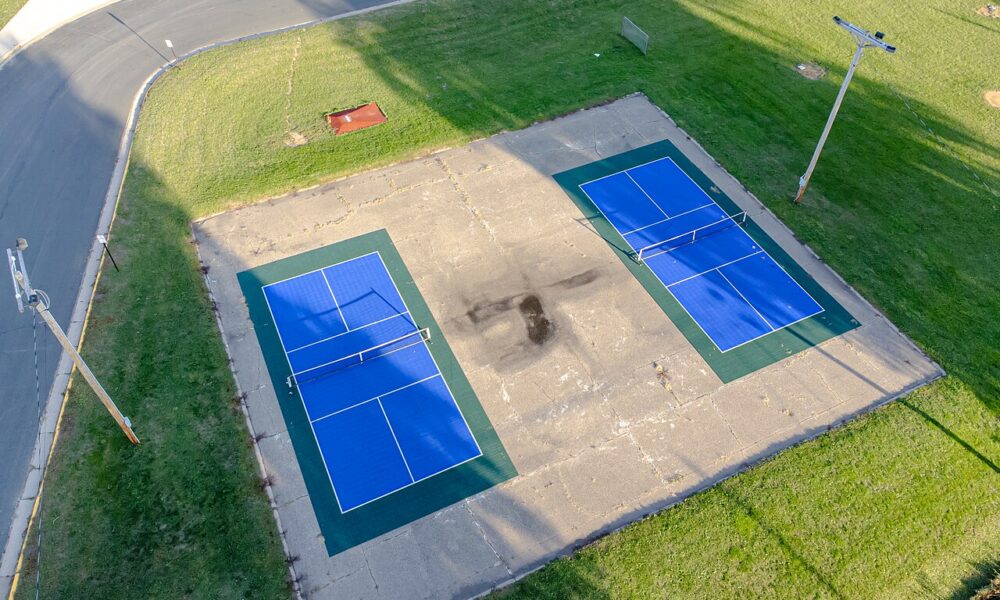
The featured image is an actual aerial photograph of two outdoor pickleball courts. You can see the painted transverse boundary lines roughly seven feet from the nets; the strip between each line and the net is the relevant kitchen. The photo is a location reference, not a diagram pretending to show a disputed foot fault.
Each kitchen line is considered part of the kitchen. Stepping on the line while volleying is treated like stepping farther into the colored area. However, the kitchen is a two-dimensional surface area under the rules, so merely leaning your upper body or paddle across its overhead space is not automatically a violation.
Kitchen Rule vs. Volley Rule: The One-Sentence Difference
A volley is hitting the ball before it bounces on your side. The kitchen regulates volleying action, not every movement through the zone. There is no general rule that forbids a person from standing in the kitchen, nor a rule that forces someone who hit a bounced ball there to get out immediately.
For example, during a slow dink rally you may step into the kitchen to play a low ball that has bounced. The next opponent’s shot may also bounce before you hit it. You can continue to exchange bounced shots from there. If you plan to take a later shot out of the air, then you must move outside and satisfy the re-establishment rule first.
12 Pickleball Kitchen Calls: Legal or Fault?
| What happened? | 2026 ruling | Why |
|---|---|---|
| 1. You stand inside the kitchen during a dink rally | Legal | Standing there is not a fault. You may hit a ball after it bounces. |
| 2. You volley with a toe on the kitchen line | Fault | Every boundary line around the NVZ belongs to the NVZ. |
| 3. You volley from just outside the line | Legal, if other rules are met | Neither player nor connected items may contact the zone during the volley, and the momentum must remain legal. |
| 4. You reach your paddle over the kitchen | Legal, if nothing touches the zone | The restricted zone is the ground area, not an invisible vertical wall. |
| 5. Your volley momentum makes you step on the line afterward | Fault | Momentum from that volley extends the act even after the ball is dead. |
| 6. You hit a winner, then fall into the kitchen due to that volley | Fault | A winning shot does not erase the later momentum fault. |
| 7. You step out with one foot and volley before placing the other outside | Fault | After touching the NVZ, both feet must re-establish on the playing surface completely outside it. |
| 8. You jump directly from the kitchen and volley while airborne | Fault | Airborne movement without both feet first re-establishing outside does not reset position. |
| 9. A ball bounces and you strike it from inside the kitchen | Legal | The prohibition is against volleying, not striking a bounced ball. |
| 10. Your paddle touches the kitchen ground during your volley | Fault | Items connected to the volleying player are counted for zone contact. |
| 11. Your partner is inside the kitchen as you volley from outside | Usually legal | The partner’s presence alone is not a fault, but prohibited connection/contact caused by your volley can be. |
| 12. The serve touches the kitchen line | Fault (short serve) | The serve must clear the non-volley zone including its boundary; a later rally ball on that line is in. |
The table assumes ordinary standing play under the standard USA Pickleball 2026 rules. Inclusive wheelchair and adaptive play has separate modifications; local recreation leagues and professional tours may also appoint different competition rules.
The Most Misunderstood Kitchen Fault: Momentum
Imagine a player volleying just behind the NVZ boundary. The paddle makes clean contact, the ball lands as a winner and everyone stops. But the player continues falling forward because of the volley, placing a foot on the kitchen line. Under Rule 11.A.2, this is still a non-volley-zone fault, because the prohibited contact was caused by the momentum of the volley. The ball being dead does not erase it.
Now compare a different case: the player volleys legally while balanced, stops and regains control, and later makes an unrelated choice to step forward into the kitchen. That later contact is not automatically a fault from the earlier volley. The key question is whether the contact remained part of the continuing volley-driven momentum.
What counts as momentum?
In everyday coaching language, momentum is the movement created by the stroke and body motion. A player may take several steps after the hit before regaining balance. Referees consider whether the motion resulting from the volley still caused the zone contact. It is not simply a fixed number of seconds or a rule that every step after a volley must be backward.
Can your partner cause a momentum fault?
Yes, when your momentum causes you to contact a person or item that is already touching the NVZ. For example, after volleying, a player may fall against their teammate standing in the kitchen. Rule 11.A.2 includes connected contact. The partner standing there was not necessarily doing anything wrong independently; the issue is the volleying player’s momentum.
Leaving the Kitchen: Why Both Feet Must Re-Establish
Rule 11.A.3 addresses the sequence after a player has touched the zone. Before volleying again, the player must place both feet on the playing surface entirely outside the kitchen. Stepping one foot out while the other remains on the kitchen line is not enough. Nor can a player jump out from the kitchen and volley in the air before either foot has properly re-established outside.
This prevents a player from exploiting the kitchen by bouncing or leaping out at the last instant while still effectively coming from the prohibited zone.
A reliable sequence
- Enter the kitchen for a ball that has bounced.
- Finish the shot and move back without crossing into your partner’s path.
- Plant one foot completely outside the NVZ line.
- Plant the other foot completely outside the NVZ line.
- Only then prepare to volley a later ball, staying balanced enough that the next volley’s momentum will not carry you across the line.
The sequence is easier if you avoid parking both feet against the boundary. Leave a little room to recover after contact, especially during fast exchanges.
Can You Reach Over the Kitchen and Hit the Ball in the Air?
Yes, in the ordinary case: the NVZ boundary is on the court surface. If both feet are established outside as needed, and you or your connected equipment do not touch the line or zone during the volley or through its momentum, you may lean over the painted area and strike a ball out of the air. A paddle passing above the kitchen line is not the same as that paddle touching the court.
But the net still has its own rules. Do not assume you may strike the ball on the opponent’s side of the net or touch the net itself merely because the NVZ rule allows a reach into the space above your own kitchen. These are distinct decisions governed by the rest of the rulebook.
Is the Kitchen Line In or Out?
It depends on what is making contact and when:
| Situation | Line treatment |
|---|---|
| A rally ball lands on the kitchen boundary line | In; it has touched the court |
| A served ball lands on the kitchen boundary line | Service fault; the serve must clear the non-volley zone |
| A volleying player’s shoe touches the line | Kitchen contact; fault |
| A player’s paddle passes above the line without touching it | Not a fault from NVZ overhead position alone |
| A player hits a bounced ball while standing on the line | Allowed under the NVZ volley restriction |
The serve is a special case and also must land within the diagonal service court as prescribed. The general “a ball on the line is in” principle is not a license for a serve to clip the kitchen line.
What About Ernes, ATPs and Other Advanced Shots?
An Erne is an advanced shot in which a player positions or jumps outside the court boundary around the non-volley zone to volley near the net. It can be legal when the player does not break the applicable NVZ contact and re-establishment rules or any separate net and opponent-court rules. Jumping over the kitchen does not exempt the player from a momentum fault when they land.
An around-the-post (ATP) shot takes the ball around the outside of the net post. A bounced ATP and a volleyed ATP have different implications for NVZ restrictions: if the ball is volleyed, the ordinary NVZ conditions apply to the player. Do not confuse a ball’s path around the post with immunity from kitchen faults.
How Kitchen Rules Differ in Wheelchair and Adaptive Play
USA Pickleball’s 2026 rules include specific wheelchair and adaptive-standing provisions. For wheelchair play, the relevant chair wheels and repositioning tests differ from the standard two-foot standing rule; some small stabilizing wheels may enter the zone in circumstances that do not create the same fault. Adaptive standing athletes using assistive devices have their own contact conditions.
Always consult Section 25 for these situations. It is inaccurate to apply a blanket “both feet outside” statement to every participant and every adaptive format.
Three Drills to Reduce Kitchen Line Faults
Drill 1: Bounced ball vs. volley call
Place one partner near the net and the other at midcourt. Toss alternating balls that bounce near the kitchen and gentle balls meant to be volleyed. The player must announce “bounce” or “volley” before striking and adjust feet accordingly. The learning objective is the decision, not the power of the shot.
Drill 2: Two-foot re-establishment
Stand inside the kitchen, then retreat deliberately until both shoes are completely behind the boundary. Call “one-two-out,” settle into balance, and then accept a soft volley from a partner. Repeat on both sides of the court. Stop and reset if a foot touches the line.
Drill 3: Momentum control after a firm volley
Stand a comfortable distance behind the line. Take controlled volleys and finish each with a balanced position. Gradually increase pace while keeping a small cushion behind the boundary. The goal is not to reach as far forward as physically possible; it is to hit a clean ball without an uncontrolled fall into the zone.
For applying this positioning to offense, our third-shot drop guide explains how to move toward the kitchen after a softer transition shot.
How to Settle a Kitchen Dispute During Rec Play
- Pause and identify whether the shot was a volley or a bounced-ball return.
- Ask whether the player’s body, clothing, paddle or connected teammate touched the kitchen line or surface as part of volleying.
- If contact happened after the hit, consider whether it was still caused by the volley’s momentum.
- If the player came from inside the zone, check whether both feet had fully re-established outside first.
- In officiated competition, follow the assigned official’s responsibilities and the tournament’s applicable dispute procedures. In social play, state the rule clearly and agree how to resolve unobserved calls without escalating.
The official rulebook controls when an informal explanation and the current rules disagree. In particular, online articles still quoting 2025 Rule 9 numbers may not reflect the 2026 reorganization, which places non-volley-zone provisions in Section 11.
Frequently Asked Questions
Can I stand in the kitchen the whole rally?
You may stand there when not volleying, but you cannot legally volley from that position. You also may need to leave before the next out-of-the-air shot.
Can I step into the kitchen after hitting a volley?
Not if your volley momentum carries you into the kitchen. If you have already regained balance and later step in for a separate reason, the analysis changes.
Does one foot touching the line count?
Yes. The entire kitchen boundary line is considered part of the zone, so a toe on the line during a volley is enough for a fault.
Is there a three-second kitchen rule?
No. The standard USA Pickleball non-volley-zone rule is about volley contact, recovery and momentum—not about a time limit for standing there.
Can my paddle be over the kitchen?
Yes, the paddle may be in the space above the zone without automatically creating a fault, so long as neither the player nor an item connected to them contacts the zone during the volleying action and all other rules are satisfied.
Is a serve on the kitchen line good?
No. It is a short serve and a fault. That is different from an ordinary rally shot touching the same line.
Official Rule Sources and Image Credit
Primary reference: 2026 USA Pickleball Official Rulebook (PDF), especially definitions, Rule 3.A.4.c on the zone, Section 11 on NVZ infractions, Section 25 on inclusive play and the service placement rules. See also the official rules hub for changes and replacement editions. This guide does not override a competition’s designated ruleset.
Featured real aerial photograph: Wikideas1 / Wikimedia Commons, CC0 public-domain dedication; resized to 1,280 pixels for web. Two outdoor pickleball courts and their painted lines are visible; no imaginary play or specific umpiring call is depicted.