
Quick answer: The most familiar baseball pitch grips are the four-seam fastball, two-seam fastball, changeup, cutter, slider, curveball and splitter. Their names describe a combination of seam orientation, finger placement, release and intended movement—not a guaranteed shape that every pitcher can reproduce. For a beginner, a comfortable four-seam fastball and a well-controlled changeup are more useful than collecting seven grips without being able to throw strikes.
This guide describes what your fingers are doing, what each pitch is meant to accomplish and how to test it safely. It is a practical introduction, not individualized pitching instruction. Younger players should work with qualified coaches and follow their league’s age-appropriate pitch-count and rest guidance.
Learn the Seams Before You Copy a Grip
A regulation baseball has two curved red-seam tracks. Rotate the ball slowly in your hand until you can see the horseshoe-shaped sections. With a four-seam grip, the index and middle fingers cross the seams so the spinning ball presents four seam crossings to the direction of flight in each full revolution. With a two-seam grip, those fingers run more along a pair of nearby seams. These descriptions concern the orientation at release, not the number of fingers touching leather.
Basic hand position: Use the index and middle fingers on top, thumb underneath for support, and a relaxed gap between the palm and ball when possible. Avoid pinching the ball unnecessarily. Smaller hands may require a different, comfortable spacing than professional examples.
Quick Comparison: Seven Common Baseball Pitch Grips
| Pitch | Basic finger placement | Typical intent | Beginner priority |
|---|---|---|---|
| Four-seam fastball | Index and middle fingers across seams, thumb beneath | Reliable, often straighter high-speed fastball | Learn first |
| Two-seam fastball / sinker family | Index and middle fingers roughly along close parallel seams | Arm-side run and potentially sink | After fastball control |
| Changeup | Deeper hold using multiple fingers or a circle-change arrangement | Lower speed with familiar-looking arm action | Useful second pitch with coaching |
| Cutter | Fastball-like hold, subtly shifted across the ball | Short movement toward glove side for many pitchers | More advanced |
| Slider | Offset pressure toward one side of the ball | Glove-side and/or downward break | Learn under supervision |
| Curveball | Finger along seam with an off-center hold | Pronounced downward or diagonal breaking action | Learn with a qualified coach |
| Splitter | Index and middle fingers spread wider than a fastball grip | Late-looking downward action, often reduced speed | Not ideal for very small hands |
Movement varies: Spin axis, spin efficiency, release angle, velocity, aerodynamic effects and individual anatomy all matter. The same label does not guarantee the same pitch behavior for two pitchers. This is also why professional pitchers’ exact pressure instructions are not universally transferable.
1. Four-Seam Fastball Grip: Your Starting Point
- Find the horseshoe area of the seams.
- Lay the pads of your index and middle fingers across the seams, separated by a comfortable small gap.
- Support the underside with your thumb.
- Keep the ball from being jammed deep into the palm and practice a comfortable, repeatable release.
A four-seam fastball is the foundation for many other pitch types because it teaches repeatable hand position and direction. A consistent grip lets the pitcher focus on footwork, balance, target selection and overall throwing action rather than exotic finger tricks. At an introductory level, judge the pitch by whether it reaches a chosen spot safely and regularly—not by whether it visibly rises.
Common error: Turning the wrist aggressively to make a fastball “move.” This can create inconsistency without solving poor grip or timing. Film from the side if your coach permits and assess your normal throwing motion.
2. Two-Seam Fastball: What Changes From Four Seams?
Turn the ball until two nearby seams provide roughly parallel tracks for the index and middle fingers. Keep the thumb supporting from below. Many pitchers use a pressure pattern that produces arm-side movement, while some see more sinking action. A two-seam fastball and a sinker are often grouped together in informal discussion, but baseball tracking systems and individual coaches may distinguish pitches based on the actual movement profile.
Do not assume the two-seamer is automatically slower or that every grip variation creates obvious run. First throw it at modest effort to the same target as your standard four-seam pitch. Compare where the catcher receives each ball rather than relying on the name.
3. Changeup Grip: Take Speed Off Without Telegraphed Effort
A changeup is intended to look like a fastball during delivery while arriving slower. Common variations include a three-finger hold and a circle-change grip, where the thumb and index finger form or approximate a small circle while other fingers help guide the ball. Some pitchers prefer the three-finger version because it is more comfortable and easier to command.
- Start with a deeper but comfortable hold.
- Distribute contact across more fingers than the basic two-finger fastball grip.
- Throw toward the normal target without trying to force a dramatic wrist turn.
- Compare perceived effort, strike location and catcher reaction—not just speed.
Changeup effects come from the entire delivery and release, not a trick that universally slows the ball by a fixed number of miles per hour. If the grip causes discomfort, try a different accepted variation with a coach.
4. Cutter: A Fastball With a Shorter Glove-Side Action
A cut fastball usually begins with a fastball-like hand position but moves the fingers or pressure slightly off center. The goal is often a late, modest break away from the throwing-arm side. For a right-handed pitcher, that often appears as movement toward the pitcher’s left from the catcher’s viewpoint, but individual trajectories vary.
More sideways pressure is not always better. If you squeeze harder, twist the wrist or sacrifice control, the result may be simply an inaccurate fastball. Advanced pitchers should distinguish a cutter from a slider based on actual flight, not solely their chosen finger placement.
5. Slider Grip: Why the Break Can Look Different
A slider uses a grip and release that generate a different spin orientation from a typical four-seam fastball. Many slider variations apply more pressure through the middle finger with an off-center seam alignment. A sweeper, a tight short slider and a more vertical slider can all look very different despite similar everyday labels.
Do not try to manufacture break by violently snapping or twisting the forearm. Young or inexperienced pitchers should not add advanced breaking pitches without good coaching, appropriate physical readiness and a manageable workload. Movement quality should never come at the cost of pain or a loss of a repeatable throw.
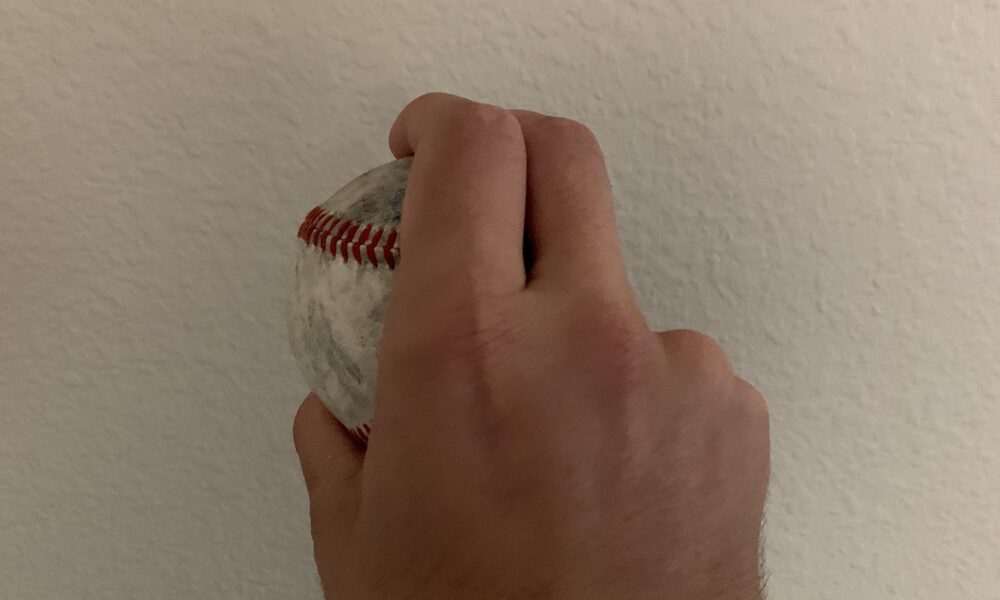
6. Curveball Grip: Finger Placement and the Photo
The featured photograph shows a real curveball grip example. Notice that the fingers contact the ball off center near the red stitching rather than crossing two seams in a textbook four-seam arrangement. Some pitchers place the middle finger along a seam and let the index finger rest beside it; others adapt the location and pressure to their hand size.
Curveballs are known for their topspin or topspin-rich spin axes, creating a downward component of break, often with lateral movement too. There is no single perfect grip that makes every pitcher throw an identical “12–6” curve. Ask a knowledgeable coach to assess throwing action and readiness before experimenting with forceful breaking-ball practice.
7. Splitter Grip: A Wider Fastball Hold
The split-finger fastball spreads the index and middle fingers wider around the ball than a typical fastball grip. Many pitchers use it to create reduced speed and pronounced falling or fading action relative to their harder pitch. Because of the finger spread, the grip may feel uncomfortable for smaller hands and should not be forced.
The splitter is not the same as simply letting go of a ball held by two fingertips. Good control requires an individual fit, stable release and careful practice with an experienced instructor.
Choose the Right Pitch Grip for Your Skill Level
If you are new to pitching
Build a reliable four-seam fastball first. Learn how the ball comes out of your hand with a consistent release, repeatable footwork, good balance and a clear target. Once that is comfortable, ask your coach whether a simple changeup or two-seam variation is appropriate for your age and skill.
If you already throw consistent strikes
Compare a small number of grips rather than chasing all seven. Track how often each ball reaches the intended strike-zone area, how it differs from the primary fastball and how well it works without additional physical stress. A pitch that moves dramatically but misses the target every time is not automatically a valuable addition.
If a grip hurts
Stop. Finger, elbow or shoulder pain is a warning to end the throwing activity and seek guidance from a qualified healthcare professional or sports-medicine provider. Never try to “push through” pain to master a named pitch.
A Simple 15-Minute Grip Practice Without Max-Effort Throwing
- Minutes 0–3: Explore seam positions. With no throwing, rotate a ball and identify the standard four-seam and two-seam finger locations.
- Minutes 3–6: Grip-and-release feel. Lightly toss the ball into a glove or to a partner at a safe distance using ordinary throwing effort, not pitching at full intensity.
- Minutes 6–10: Four-seam target practice. Use an age-appropriate distance and the throwing volume approved by your coach. Focus on smooth mechanics and direction.
- Minutes 10–12: Changeup feel. Compare a coach-approved comfortable changeup grip at easy effort, without trying to squeeze the ball or create forced movement.
- Minutes 12–15: Note your results. Record which grip felt repeatable, which target was easiest, and whether fatigue or discomfort appeared. Do not add more throws just to chase one perfect attempt.
Workload note: These time boxes describe organization, not a recommended pitch count. Do not exceed applicable total workload, rest-day guidance or individualized advice.
Why Pitch Counts, Rest and Age Matter More Than a Clever Grip
Overuse is a major preventable concern in youth pitching. The MLB and USA Baseball Pitch Smart program emphasizes age-appropriate workloads, adequate days off, avoiding year-round specialization and not throwing through pain. The correct workload limits depend on age and competition rules; they are not the same for every player.
A 12-year-old and an adult competitive pitcher should not use an identical program simply because they are learning the same named pitch. Keep a record of game and practice throwing, follow the applicable league’s pitch-count and rest rules, and seek instruction before experimenting with advanced grips.
How Do Grip Choices Relate to Baseball Strategy?
Pitch selection changes the type of contact a hitter is more likely to make, but outcomes depend on execution and opposing hitters as well as pitch movement. A well-located fastball can be more effective than a poorly controlled breaking pitch. Coaches also consider count, catcher target and the team’s defensive positioning.
If you are learning the broader roles around the pitcher, start with AVARIXO’s guide to all nine baseball fielding positions. For how pitching success appears in box-score statistics, our ERA explanation and WHIP guide explain two widely used measures.
Common Questions About Baseball Pitch Grips
What baseball pitch grip should beginners learn first?
A comfortable four-seam fastball grip is a sound first choice. It supports practice in consistent throwing and strike location without introducing too many variables.
Are two-seam and four-seam grips the same?
No. Both commonly use the index and middle fingers and supporting thumb, but the seam orientation differs. That can affect how the ball spins and moves, though every player gets different results.
What is the difference between a changeup and a splitter?
Both can arrive slower than a hard fastball and may show downward action, but a changeup often uses a deeper or multi-finger grip while a splitter spreads the two main fingers more widely. Neither pitch type has one universal professional grip.
Can I learn a curveball just by looking at a photo?
The image can illustrate where fingers sit on the ball, but an effective, safe pitch also depends on mechanics, physical readiness, workload and instruction. Do not use a photo as a substitute for coaching.
Which pitch moves the most?
There is no single winner. A sweeping slider may have more horizontal break, a curveball may have greater downward break and a sinker may show arm-side or sinking movement. Speed, spin, release and conditions influence every pitch.
Sources and Image License
For workload recommendations and injury-prevention guidance, consult the official MLB Pitch Smart program. For the basics of a fielding position and score interpretation, see the relevant linked AVARIXO baseball explainers.
Featured photograph: Benjamin Charles Baird / Wikimedia Commons, CC BY-SA 4.0. Photo resized for web; it illustrates one curveball grip rather than every grip in this guide.

Other Articles
OG Fortnite Skins: What Counts as Original and How Rarity Changed