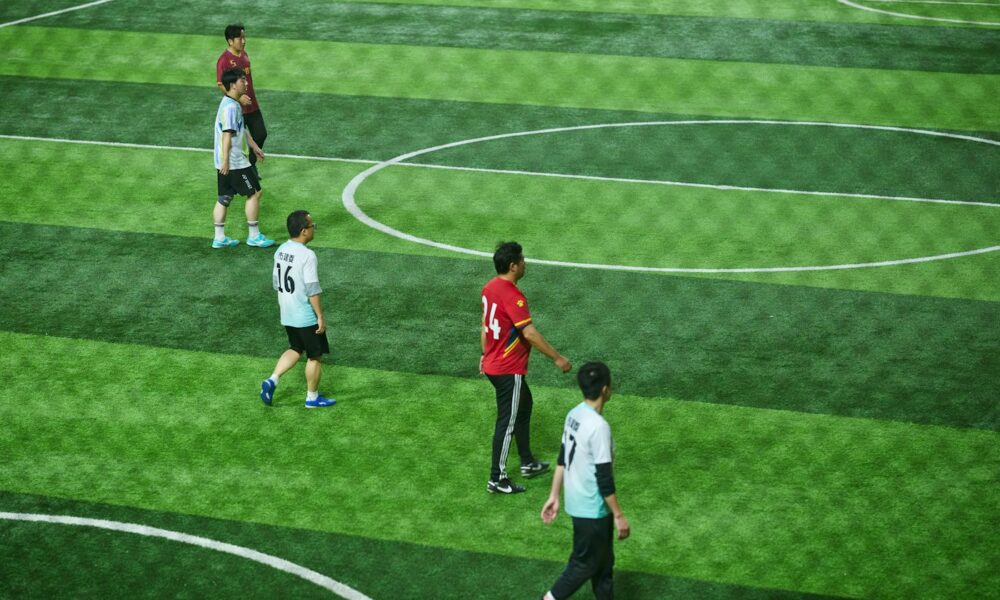

For U.S. Soccer’s U9-U10 7v7 pathway, the official example formation is 1-3-2-1: one goalkeeper, three defenders, two midfielders and one forward. A 1-2-3-1 shape, usually shortened to 2-3-1 when the goalkeeper is omitted, is a common alternative that can create natural width and simple passing triangles. Both shapes use six outfield players plus one goalkeeper, and neither is mandatory for every league or team.
How do you read 7v7 soccer formations?
Formation numbers usually count only outfield players, working from the back toward the opponent’s goal. In 2-3-1, the two defenders form the deepest outfield line, three midfielders operate ahead of them, and one forward leads the attack. Adding the goalkeeper gives seven players. You may see the same setup written as 1-2-3-1 when the goalkeeper is included in the notation. Likewise, 3-2-1 can be written 1-3-2-1.
In many U.S. grassroots programs, 7v7 is associated with the U9 and U10 age groups, although actual age brackets and rules depend on the organizer. Always check the league’s competition rules before choosing training plans or field markings. For a guide to the larger format, read AVARIXO’s 11v11 soccer formations overview.
2-3-1 formation: a width-focused alternative
Shape: goalkeeper; two defenders; left, center and right midfielders; one forward. This setup provides width naturally. The outside midfielders can offer a passing lane near the touchline, while the central midfielder helps connect the defenders to the striker. Because the ball can move around the field rather than straight through the middle, the team can learn combination play, supporting angles and recovery runs.
Roles in a 2-3-1
- Goalkeeper: organize short restarts, communicate and look for safe passing choices.
- Two defenders: offer short options, spread out in possession and cover each other when defending.
- Central midfielder: show for the ball between lines, turn when possible and track central counterattacks.
- Left and right midfielders: use width in attack, then recover to help the defenders.
- Forward: provide depth, threaten space behind the defense and be available for combination passes.
Main advantage: simple spacing and multiple passing angles. Main weakness: the two defenders can be exposed when outside midfielders stay high or the central midfielder loses the ball. Coaches should train quick reactions to turnovers, not force children to remain in fixed zones for an entire match.
3-2-1 formation: more cover at the back
Shape: goalkeeper; three defenders; two midfielders; one forward. An extra defender makes the last line more secure and can give young players confidence when the opposition repeatedly attacks the wide channels. The two midfielders must cover a large area, however, and the lone forward can become isolated.
Choose this formation when a team has trouble protecting space behind its defenders, or when it needs a gradual progression toward playing confidently out from the back. Its tradeoff is less obvious width high up the field: an outside defender may need to join the attack, with a teammate covering. It should not become a permanent invitation to kick long balls every time the goalkeeper receives possession.
2-2-2 and 3-1-2: when to try alternatives
A 2-2-2 gives two defenders, two midfielders and two forwards. It can be easy to explain to beginners but may stretch the midfield and leave a gap in the center. A 3-1-2 supplies three defenders, one central midfielder and two forwards, creating immediate attacking support while asking a great deal of the lone midfielder. These options can be useful in training exercises or short match segments, but the coach should prioritize children’s participation, decision-making and learning over tactical novelty.
How the U.S. 7v7 build-out line changes tactics
Some U.S. youth leagues use a build-out line across each half of the field, between the penalty area and halfway line. Its purpose is to give the team restarting from the goalkeeper or a goal kick more space to play short passes. Opponents retreat behind the line for the applicable restart and can then press in accordance with the local rules. It also affects where offside can be called in participating leagues.
The New Jersey Youth Soccer explanation of U.S. Soccer’s Player Development Initiatives describes the build-out line, goalkeeper distribution restrictions and offside area. It is an example of league implementation, not a substitute for today’s specific tournament rules. General adult 11v11 rules do not include this youth build-out marking. For regular goal-kick fundamentals, see our soccer goal kick guide.
A simple build-out pattern for the 2-3-1
- The two defenders separate to offer visible short options to the goalkeeper.
- The central midfielder moves out of the opponent’s cover shadow, offering a diagonal pass rather than standing directly behind a marker.
- An outside midfielder stays wide and another player offers a forward option.
- The receiver checks for pressure before passing to the next player, rather than forcing a rehearsed route.
- If the central option is blocked, move the ball sideways or back to create a new angle; encourage a safe reset instead of a blind ball into traffic.
The aim is not to ban longer passes but to teach players why they choose a pass. The defensive players should learn to recognize the moment to step forward and the moment to recover.
Three short coaching drills for a 7v7 team
1. Four-player passing diamond (8 minutes)
Set up a small diamond with one ball. Players pass, follow the ball and communicate before receiving. Progress by adding a light defender to encourage scanning and support angles. Focus on open body position, not pass speed.
2. Build out against two pressers (10 minutes)
Use a goalkeeper, two defenders and one midfielder against two pressing opponents, with target gates farther upfield. Restart from the goalkeeper; award a point for reaching a gate through controlled combinations. Rotate all positions.
3. Transition to defense (8 minutes)
In a small-sided game, call a change of possession and ask the nearest player to pressure the ball while teammates recover centrally. Reinforce the distinction between the first defender and the supporting cover player. Avoid overloading beginners with multiple instructions at once.
How should a coach choose between formations?
Begin with your players’ ability to spread out, offer support and recover. Use 2-3-1 if they need an accessible balance between width and central connection; test 3-2-1 if the defending line needs more stability. Rotate positions over a season so children learn multiple skills. Measure progress through involvement and decisions rather than solely the match result.
FAQ
Does 7v7 mean seven outfield players?
No. The format has seven players on the field for each side in total, normally six outfield players and one goalkeeper.
Which 7v7 formation should U9 and U10 use?
U.S. Soccer’s official U9-U10 example is 1-3-2-1. A 2-3-1 can still be a useful alternative for teams that want more natural width. The best choice depends on player development goals and local competition rules.
Do all youth leagues use the build-out line?
No. Rules and age categories vary. The line is widely associated with U.S. Soccer’s small-sided player development initiative, but coaches should check their specific league documents.
Is a 2-3-1 better than 3-2-1?
Not categorically. The 2-3-1 often improves natural width; the 3-2-1 can offer more defensive security. Both can develop good soccer habits when coached well.
Sources and verification
Checked October 11, 2026. Primary formation reference: U.S. Soccer U9-U10 7v7 development guide, which uses 1-3-2-1 as its example shape. Additional references: New Jersey Youth Soccer PDI implementation and build-out-line FAQ; Cupello 7v7 formations guide. The alternative formations and drills are editorial coaching examples, not mandated federation schemes.

Other Articles

Panenka Penalty Explained: Why the Soft Chip Works and When It Fails