
An NBA backcourt violation occurs when an offense illegally sends or returns a controlled ball from its frontcourt to the backcourt and is the first to touch it there. It is easy to confuse that call with the eight-second violation, which happens when the team fails to advance the ball beyond midcourt quickly enough. Both cost possession, but they are different restrictions.
The NBA’s definitions turn on court position, control and which player touches the ball—not simply whether a pass crosses a painted line. Below are clear game scenarios, common exceptions and practical ways to tell the calls apart. Primary sources: NBA Rule No. 8 and NBA Rule No. 10, checked October 11, 2026.
Backcourt vs. frontcourt: which half belongs to the offense?
The offensive team’s backcourt is the half containing its own defensive basket. Its frontcourt is the half containing the basket it is trying to score on. As teams switch ends at halftime, the meaning changes with the direction of attack. The center line itself belongs to the backcourt for these definitions; a player’s foot on it can make the player backcourt for control purposes.
For a player holding the ball, the NBA treats the ball as being in the frontcourt only when neither the player nor the ball is touching the backcourt. A dribbler has a stricter threshold for advancing: the ball and both feet must be in the frontcourt. That detail explains a seemingly odd replay in which a guard has a foot beyond halfway but the eight-second count continues.
The NBA’s 8-second violation
The offense has eight seconds to bring the ball from its backcourt into the frontcourt. This is a team-possession rule, not a requirement that any individual player cross the line. Passing can advance the ball as efficiently as dribbling. If the count expires while the team continues to possess the ball in the backcourt, the opponents receive the ball at the specified midcourt location.
Imagine a guard inbounding the ball deep in the backcourt. The guard dribbles cautiously for several seconds while pressured by a defender. By the time the referee’s count reaches eight, the ball has not legally reached the frontcourt. That is an eight-second violation even though the player may have crossed one foot over halfway.
Does the eight-second count always reset after a stoppage?
No. What happens next depends on why play stopped. NBA Rule No. 10 lists specific circumstances in which a fresh eight seconds are awarded, including certain defensive kick-ball or punch violations, a defensive personal or technical foul, a defensive delay-of-game warning, and the specified infection-control interruption. A defensive team cannot count on every ordinary whistle wiping out the offense’s prior count. For an actual play, consult the league’s current rule text and official ruling.
What is an over-and-back violation?
“Over-and-back” is common shorthand for the ball-in-backcourt violation. Once an offense has established frontcourt status and still controls the ball, it generally cannot cause the ball to enter its backcourt and then be the first team to touch it. A player may not rescue a bad pass simply by chasing it over the midcourt line.
Example A: A guard in the frontcourt passes to a teammate who is still in the backcourt. The teammate receives it with control. That is ordinarily a backcourt violation.
Example B: A defender deflects the frontcourt pass back across midcourt, and the offensive team recovers it. The touch by the defender matters: this is not automatically an offensive over-and-back. Distinguish a genuine defensive touch from a ball that merely slips from an offensive player’s hands.
Example C: A loose rebound is batted toward midcourt and nobody yet has control. The special no-team-control situations in the rulebook may change whether backcourt restrictions apply. A referee must decide the sequence of touches, possession and control, not just where the ball lands.
What counts as crossing midcourt while dribbling?
Think of three moving parts: the ball, the left foot and the right foot. Under the NBA frontcourt/backcourt definition, a dribble has not attained frontcourt status until all three are fully in the frontcourt. A dribbler who straddles the midcourt line can still be establishing frontcourt status. By contrast, for a player holding the ball, the ball or player touching the backcourt means it is still in the backcourt.
The precise first-touch and team-control definitions can become crucial on a replay. That is why there is not a universal answer to “the ball crossed half court, so was it legal?” without knowing who touched it next.
When the ball may legally go back
There are important exceptions to the usual no-return rule. Among the situations the NBA identifies are a ball touched by the defense, certain plays with no team control such as rebounds and jump-ball situations, and special late-game inbounding cases. During the final two minutes of the fourth period and final two minutes of overtime, an eligible timeout advance and subsequent throw-in can affect frontcourt/backcourt status under the league’s detailed procedures.
Do not assume that an offensive player can intentionally retreat over halfway after a routine established possession merely because a timeout is available. The exceptions are narrow and tied to defined game situations.
Is an 8-second violation the same as a shot-clock violation?
No. The eight-second rule controls how long a team may remain in its backcourt; the 24-second shot clock limits the total offensive possession before a valid shot attempt. A possession may break the eight-second rule well before the shot clock reaches zero. Conversely, an offense can cross halfway promptly and still run out the shot clock later. For reset situations, see AVARIXO’s NBA shot-clock guide.
Why coaches care about the center line
A full-court press is partly a race against the eight-second clock. Trapping a ballhandler near the sideline encourages slower decisions and risky reversal passes. Once the offense has established the frontcourt, the backcourt line becomes an additional boundary that can take away retreat options. Offenses counter with early outlets, safe passing angles and receivers already positioned beyond halfway.
Referees look at the entire sequence; spectators benefit from watching the location of the ball, both feet of a dribbler and the last player to touch the ball. That is more reliable than reacting to the direction of a pass in isolation.
Quick FAQ
How long does an NBA team have to cross half court?
Eight seconds under the NBA rule, subject to the specific reset and possession provisions.
Is the center line frontcourt or backcourt?
It is part of the backcourt for the relevant NBA status definitions. A dribbler must have both feet and the ball in the frontcourt to establish frontcourt status.
Can you pass back after crossing half court?
Ordinarily not when your team controls the ball, caused it to enter the backcourt and touches it first. A defensive deflection or other specific exception can change the outcome.
Is backcourt a personal foul?
No. It is a violation, usually resulting in loss of possession rather than a personal foul assessed to an individual.
Does college basketball use the exact NBA clock rule?
No. Different leagues publish their own timing rules, so do not assume NBA eight-second language applies to every college or international game.
Sources and photo credit
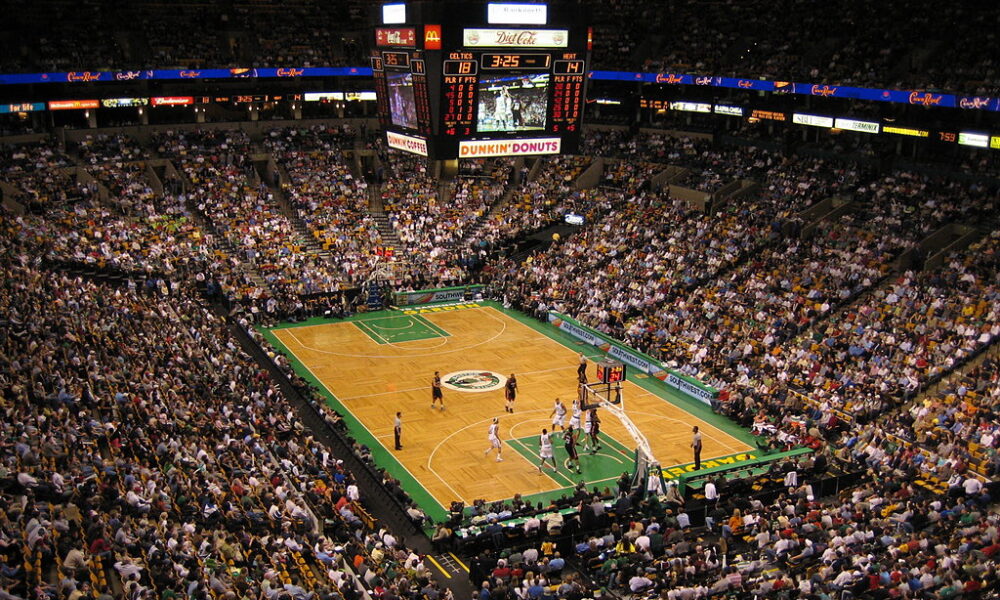
Rules cross-checked with NBA Rule No. 8, Out-of-Bounds and Throw-In and NBA Rule No. 10, Violations and Penalties. Featured photo: Celtics vs Heat in 2006, ReneS / Wikimedia Commons, CC BY 2.0. Rules checked October 11, 2026.

Other Articles