
A power play in ice hockey occurs when one team has more skaters on the ice than its opponent because of a penalty. In a familiar NHL example, five skaters attack against four defending skaters while the penalized player serves a minor penalty. The attacking side has the numerical advantage; the defending side is called shorthanded.
Power plays do not guarantee a goal. The shorthanded team can defend, clear the puck and even score itself. Whether a power play ends early depends on the penalty involved and the game’s actual manpower situation. Here is a practical guide to the NHL’s rules, scoring statistics and tactics, with the 2026–27 official rulebook as the primary source.
What happens when a team goes on a power play?
During normal regulation play, NHL clubs typically use five skaters plus one goaltender each. When a player receives a qualifying minor penalty, that player’s team ordinarily competes with one fewer skater for two minutes, leaving a 5-on-4 situation. The penalized player is usually in the penalty box while the clock counts down; the other club can position an extra attacker around the offensive zone.
A penalty can create a 5-on-3 situation when two players from the same team are serving eligible penalties at once. It is also possible to see other manpower combinations, especially during overtime. Always count the skaters; the goaltender is not included in a score graphic showing 5-on-4.
As the NHL’s 2026–27 official rulebook distinguishes, not every penalty is identical and two teams can receive penalties that affect manpower differently. A simultaneous pair of coincidental penalties, for example, does not always produce a conventional power play.
How long does a power play last in the NHL?
Minor penalty: normally two minutes
Most familiar minors are scheduled for two minutes. If the team with the numerical advantage scores while the other club is shorthanded due to an eligible minor, the appropriate minor penalty normally terminates early. That is why a power-play goal with 45 seconds left can restore even-strength play immediately.
The precise release depends on which penalties are running and whether the defending team is genuinely below the opponent’s numerical strength. A goal during coincidental 4-on-4 play does not automatically release a player simply because that player is serving a minor.
Major penalty: normally five minutes
With a major penalty that creates a manpower disadvantage, the full five-minute time generally must be served. The advantaged team can score more than one power-play goal during that period without the major automatically ending. That makes a major penalty potentially far more costly than an ordinary two-minute minor.
Double-minor: two distinct two-minute segments
A double-minor is typically four minutes, but treating it as one indivisible four-minute advantage is misleading. The two-minute components matter: a qualifying power-play goal may terminate the active segment while the other segment remains. The precise order and timing of additional penalties can complicate the calculation.
| Penalty situation | Usual starting duration | Effect of a qualifying power-play goal |
|---|---|---|
| Minor creating a manpower deficit | 2 minutes | Eligible remaining minor time generally ends |
| Major creating a manpower deficit | 5 minutes | Major generally continues despite the goal |
| Double-minor | 4 minutes split into two components | The active eligible component may end; the second remains |
| Coincidental penalties | Depends on the penalties | Not every coincidental situation produces a power play or goal-triggered release |
For exact edge cases, consult Rules 16, 18, 19 and 20 in the 2026–27 NHL rulebook. NHL rules are different from some international, college and recreational hockey competitions.
Power-play goal versus shorthanded goal
A power-play goal (PPG) is credited to a team when it scores while enjoying the applicable manpower advantage. A shorthanded goal (SHG) is scored by a team playing with fewer skaters than its opponent. Being outnumbered does not prevent a breakaway, and an aggressive penalty killer may win the puck and attack at the other end.
Imagine a 5-on-4 advantage for Team A. Team A cycles the puck, sends a pass across the slot and scores: this is the common power-play goal scenario. But if Team B intercepts that same pass and scores on a counterattack while down a skater, the goal belongs in the shorthanded category. These are scoring classifications; they do not alone tell you whether a particular penalty terminates.
What is power-play percentage?
Power-play percentage, often shown as PP%, measures how often a club converts its power-play opportunities into goals. The league’s official hockey glossary defines the underlying relationship:
Power-play percentage = (power-play goals ÷ power-play opportunities) × 100.
For example, a team that scores six power-play goals from 30 opportunities has a 20% conversion rate. Another club with four goals from 10 opportunities has a higher 40% PP%, despite fewer total goals. Always read the number alongside sample size and opportunity quality. In game coverage, not every second of power-play time creates a separate opportunity; a scorekeeper uses the league’s scoring definitions.
How teams attack on the power play
Win the entry and establish possession
The advantaged side first needs to move the puck into the offensive zone. A controlled entry can create shooting lanes, whereas a failed entry sends everyone back to regroup. Teams may vary between carrying the puck over the blue line and dumping it where teammates can retrieve it.
Move the penalty killers before taking the shot
Once set up, attackers pass quickly to shift the four defenders and expose a temporary lane. Familiar options include a point shot through traffic, a cross-ice one-timer and a quick pass to the player near the net. Shooting into a blocked lane often gives the penalty killers a chance to clear.
Recover loose pucks and protect against breakaways
An advantage can disappear if the defense wins the puck. The point player must judge when to hold the offensive blue line and when to fall back. A short-handed counterattack can produce a high-quality chance even while that team has fewer skaters.
How teams kill a penalty
The shorthanded team aims to reduce dangerous chances until its missing skater returns. A compact box or diamond defensive shape can shield the slot and challenge passing lanes. When the puck is loose, penalty killers may clear it down the ice to make the power-play unit regroup.
Rules on clearing the puck can differ while shorthanded. For a separate explanation of why long clearances sometimes are or are not called icing, read AVARIXO’s hockey icing rules guide. For a refresher on regulation period length and overtime, see how many periods are in hockey.
Does a power play automatically end when the clock reaches zero?
A standard two-minute minor expires when its remaining penalty time runs out, but play does not always stop at that instant. The penalized player may return to the ice at the permitted time and teams play on until the next whistle. In more complex situations involving concurrent penalties, serving and substitution rules can affect exactly when players re-enter. Watch the penalty clock and actual skater count rather than assuming every clock reaching zero triggers a whistle.
Frequently asked questions
Can you score on a power play more than once?
Yes, particularly during a major penalty that continues despite a goal. A normal eligible minor often ends after the advantaged team scores.
Does 5-on-4 include the goalies?
No. Those numbers refer to skaters. In the standard scenario, each club also has a goaltender.
Can the shorthanded team score?
Yes. Such a goal is a shorthanded goal when the club has the applicable numerical disadvantage.
Is a power play the same in every hockey league?
No. NHL, international and college hockey rulebooks can differ on penalties, substitution and overtime. Check the rules of the competition you are watching.
Sources and image credit
League rules checked October 11, 2026: NHL Official Rules 2026–2027, especially Rules 16–20, and NHL Hockey Glossary. The NHL also describes the historical adoption of ending eligible minors after a power-play goal.
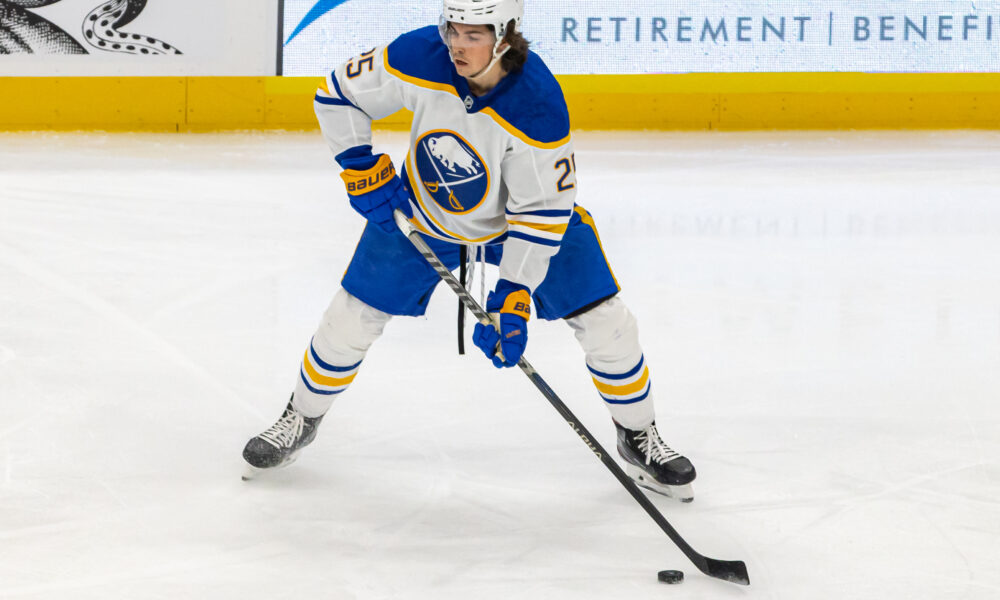
Featured photograph: Buffalo Sabres defender Owen Power controlling the puck against Seattle Kraken in 2022, by Jenn G, CC BY-SA 2.0. The image illustrates NHL game action and does not claim to depict a particular power-play opportunity.

Other Articles

Offside Trap in Soccer: How the Defensive Line Times It
Pole Position in F1: Qualifying, Grid Penalties and Sprint Rules