
There are four broad soccer position groups: goalkeeper, defenders, midfielders and forwards. In 11v11, one goalkeeper protects the goal while ten outfield players divide the tasks of winning the ball, progressing it and creating chances. The exact number of players in each line depends on the team’s formation, but the jobs are easier to understand by asking who protects space, who connects play and who threatens the opponent’s goal.
This guide explains every common position, the numbers traditionally associated with those roles, the differences between similar positions and how beginner players can recognize where they fit. It focuses on association football, also called soccer in the United States, not American football.
Soccer positions at a glance
| Position | Common abbreviation | Primary responsibility | Important skill |
|---|---|---|---|
| Goalkeeper | GK | Protect goal and organize the penalty area | Positioning, handling and distribution |
| Center back | CB | Protect central areas and stop attackers | Anticipation and communication |
| Fullback | RB / LB | Defend flanks and support buildup | 1v1 defending and recovery running |
| Wingback | RWB / LWB | Combine flank defense with wide attacking runs | Stamina and crossing decisions |
| Defensive midfielder | CDM / DM | Screen defense, win second balls and circulate play | Scanning and controlled passing |
| Central midfielder | CM | Connect defense to attack | First touch and awareness |
| Attacking midfielder | CAM / AM | Find pockets of space and create chances | Turning and through passes |
| Winger | RW / LW | Stretch defense, drive forward and combine | Movement and 1v1 ability |
| Center forward / striker | CF / ST | Threaten goal and occupy defenders | Finishing and off-ball runs |
Abbreviations vary by coaching tradition, game publisher and region. A coach may write DM rather than CDM; a broadcaster may refer to a number 9 instead of a striker. Neither changes what the player is actually doing.
Where are soccer positions on the field?
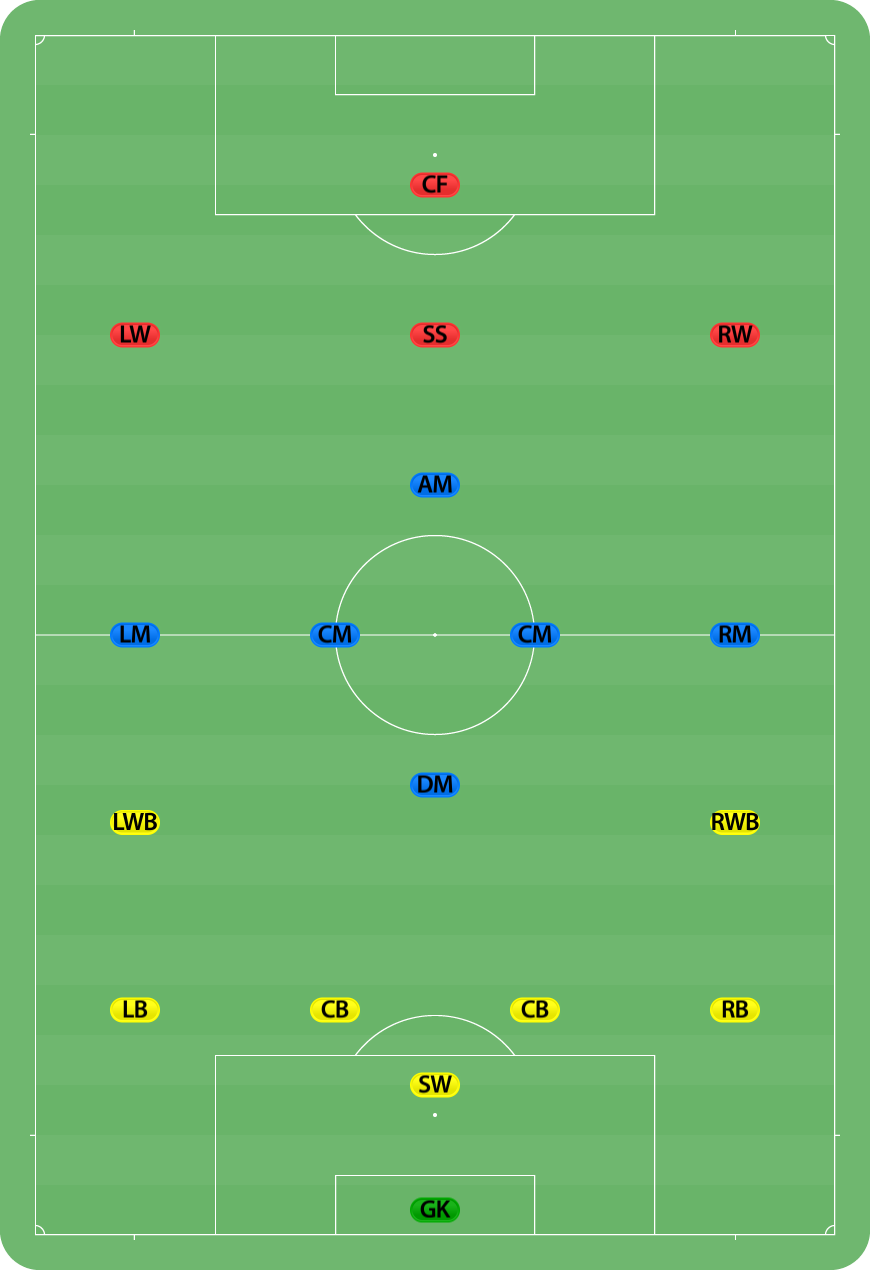
Positions diagram by Chandler, Wikimedia Commons, public domain.
The diagram is a map of likely operating zones, not a rule against movement. In a 4-3-3, a midfielder can move near a winger to form a passing triangle. In a 4-4-2, wide midfielders must often recover closer to their fullbacks. The key is that teammates understand who fills the space another player leaves.
Goalkeeper (GK): more than making saves
The goalkeeper is the only position with special handling permissions, restricted by the Laws of the Game to the player’s own penalty area and subject to other rules. Shot stopping matters, but the role also includes positioning at crosses, communication, starting attacks and choosing when to leave the line. A goalkeeper who organizes defenders before a corner can prevent a shot before needing to make a save.
For beginners, focus on setting the feet before the shot, catching manageable balls safely, calling for crosses and delivering simple passes rather than attempting risky long distribution every time.
Center backs (CB): defending the middle
Center backs are responsible for recognizing runs, protecting space behind the line and maintaining a safe distance between defenders. They cannot chase every striker into midfield; doing so may create a gap in front of goal. Good center backs talk constantly, know when to challenge and know when to delay an attacker until help arrives.
One center back may prefer to step toward the ball while the partner provides cover, but the choice must reflect how the team defends. Speed helps, but reading the attack early often matters more.
Fullback vs. wingback: what is the difference?
A fullback plays on the right or left of a back line, typically one of four defenders. A wingback has a larger up-and-down responsibility along the outside, often when a side uses three central defenders. Both can attack, but a wingback’s position generally demands a more constant combination of crossing, wide defending and long recovery runs.
The difference is not as simple as which player runs faster. In a 4-3-3, an adventurous fullback may spend much of the match high up the pitch. In a 3-5-2, a wingback may defend deep enough to create a back five. Watch the team’s shape without the ball to identify the assignment.
Defensive midfielder (CDM): the number 6
A holding or defensive midfielder often sits in front of center backs, intercepts passes, shields space and gives teammates a reliable outlet. They help prevent the defense from being exposed when an attacker loses the ball. The common nickname ‘number 6’ refers to a traditional positional convention, not necessarily the number on the player’s shirt.
This role suits a player who scans before receiving, makes simple decisions under pressure and communicates. It does not require the player to stay inside a tiny circle near the center spot.
Central midfielder (CM): linking play
A central midfielder moves between lines and helps maintain possession. Some are box-to-box runners who support both penalties areas. Others control tempo with shorter passes or carry the ball into space. Coaches often refer to two number 8s when using a midfield trio with one deeper 6.

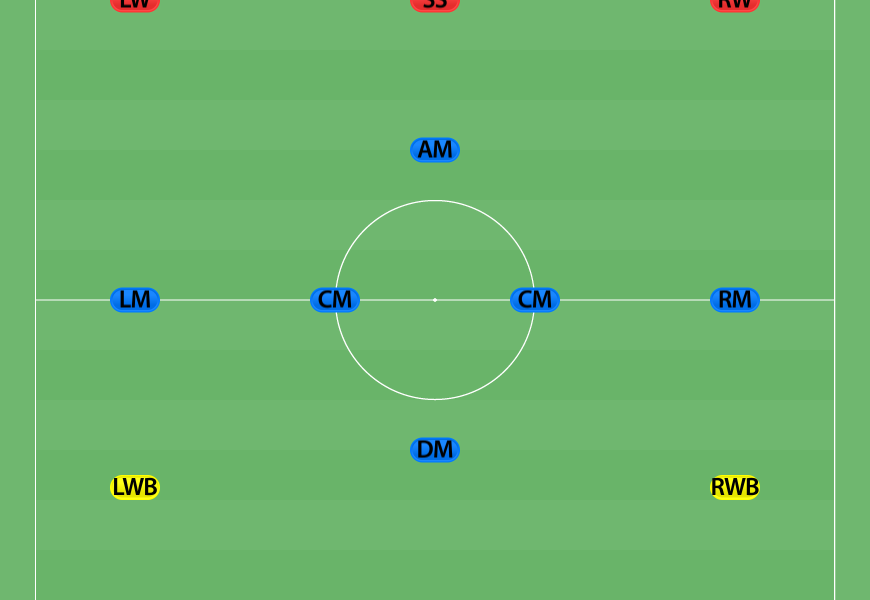
Midfield-position diagram by Tiresais, Wikimedia Commons, public domain.
Midfielders develop fastest when they learn to look over both shoulders, receive on the half-turn and offer diagonal passing angles. Those habits help in multiple formations.
Attacking midfielder (CAM): the number 10
The attacking midfielder operates closer to the striker, often between opposing defenders and midfielders. Their job is to create final passes, combine quickly and arrive near the penalty area. A classic number 10 may be a playmaker, but modern attacking midfielders are frequently asked to press and make forward runs too.
Not every 4-3-3 uses a dedicated number 10. An advanced number 8 might perform similar tasks while the team preserves three central midfielders.
Wingers (RW and LW): speed, width and decisions
Right and left wingers can provide natural width, attack fullbacks one-on-one or cut inside to combine or shoot. The best action depends on which foot the winger favors and where support arrives. A left-footed player on the right may like to drive inward, but that movement should have a purpose rather than being automatic.
Wingers also have defensive work. When their team loses possession, they may close down a fullback, protect a passing lane or recover into midfield depending on the coach’s structure.
Striker and center forward (ST/CF)
The striker is often the main goal threat, but finishing is only part of the role. Occupying center backs can open space for a winger or number 10; running into channels can stretch the opponent; pressing can force a rushed clearance. Some center forwards drop to receive and connect play, while a more traditional number 9 stays closer to goal.
For young players, teach off-ball movement early. A well-timed run creates a chance before a shot is even attempted.
Soccer position numbers 1 through 11 explained
| Traditional number | Position commonly associated with it |
|---|---|
| 1 | Goalkeeper |
| 2 | Right fullback |
| 3 | Left fullback |
| 4–5 | Defensive positions, often center back; conventions differ |
| 6 | Holding midfielder or center back in some traditions |
| 7 | Wide attacker or right-sided player |
| 8 | Central midfielder |
| 9 | Central striker |
| 10 | Attacking midfielder or playmaker |
| 11 | Wide attacker or left-sided player |
These are conventions, not official restrictions. Modern shirt numbers can be chosen for personal reasons, inherited from a teammate or assigned by a club. A defender can wear 10, and a striker can wear 4. Position names should describe the role, not make assumptions based on the jersey alone.
How positions change with formations
A 4-3-3 has a back four, midfield three and front three. A 4-2-3-1 places two deeper midfielders behind three attackers supporting one striker. A 3-5-2 commonly uses wingbacks because three central defenders provide a different base. The goalkeeper remains part of all of them, outside the formation numbers.
The best way to learn is to follow one player in a full match: observe where they start when the opponent has the ball, where they receive passes and who covers when they move. For a wider view of 4-3-3 buildup patterns, consult FIFA’s coaching exercise.
Which soccer position should a beginner try?
Start by considering decision-making, comfort with pressure, movement, communication and enjoyment—not just height or pace. A player who enjoys anticipation and organizing teammates may like defense; someone who reads space and passes accurately may find midfield rewarding; a player energized by attacking runs may enjoy a forward role.
Especially in youth soccer, rotate through different roles. Specializing too early can prevent a player from learning the whole game. Give each role clear, positive feedback: successful recoveries and smart passes are worth noting alongside goals.
Five easy drills to learn different soccer positions
- One-on-one channel defense: a defender guides an attacker away from the central goal corridor rather than diving into an early tackle.
- Midfield scanning: a central player checks both shoulders before receiving and passing to a third player.
- Fullback recovery: a wide defender supports an attack then sprints back after the coach signals a turnover.
- Striker timing: practice moving behind a defender as a passer lifts their head, with special attention to legal offside positioning.
- Goalkeeper communication: rehearse verbal calls before crosses, corners and short buildup plays.
Soccer positions FAQ
Is a winger a midfielder or forward?
It depends on the formation and assignment. In a 4-3-3, wingers are commonly described as wide forwards. In a 4-4-2, wide players may be described as wide midfielders and spend more time in a midfield line.
What position is a number 6?
Often a defensive or holding midfielder, though numbering traditions vary between countries and teams.
What is the difference between a number 8 and a number 10?
An 8 commonly links multiple phases of play in central midfield. A 10 generally operates closer to goal and creates attacking opportunities. The roles can overlap.
What does CDM mean?
Central defensive midfielder. The same role can be abbreviated DM or called a holding midfielder.
Do you need all eleven numbered roles?
No. Different formations redistribute roles. Every 11v11 side must account for one goalkeeper and ten outfield players, but there is no mandatory list of named player positions.
Read more background on tactics in the AVARIXO Football (Soccer) section. This is an original positional explainer rather than a ranking of current players or teams.

Other Articles
Tennis Scoring Explained: Love, 15, 30, 40, Deuce & Tiebreaks
Tennis Terms Explained: 45+ Words Every Beginner Should Know