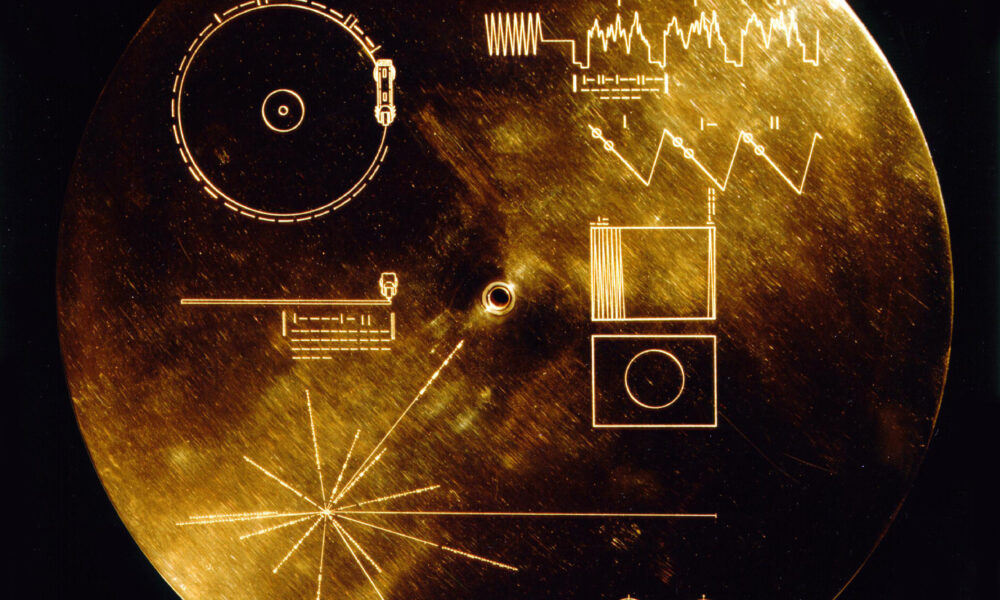
Voyager Golden Record Explained: What’s on It, How to Read the Cover and Where It Is

Quick answer: The Voyager Golden Record is a gold-plated copper phonograph record attached to each of NASA’s two Voyager spacecraft, launched in 1977. It carries images, natural sounds, music and spoken greetings intended to portray life on Earth. The records are not messages that scientists expect anyone to hear soon; they are time capsules designed to survive an extraordinarily long journey through space.
What is the Voyager Golden Record?
NASA launched Voyager 2 on August 20, 1977, and Voyager 1 on September 5, 1977. Both spacecraft carried an identical Golden Record: a physical disc containing a carefully selected collection of sights and sounds from Earth. The project was organized by a committee chaired by astronomer Carl Sagan of Cornell University.
The record was created for a hypothetical future discoverer, not as a way to communicate with an alien civilization today. Unlike a radio broadcast, its contents require someone to find the spacecraft, recognize the disc as a recording and work out how to play it.
What’s on the record?
The selection combines human culture with a scientific introduction to Earth. Rather than representing one country, the team tried to communicate something about the planet’s environments, living things and people.
| Content | What it includes | Why it matters |
|---|---|---|
| 115 images | Photographs and diagrams of Earth, people, animals, plants, landscapes and scientific concepts | Offers visual context about the planet and its inhabitants |
| Greetings | Short spoken messages in 55 languages | Introduces the diversity of human speech |
| Sounds of Earth | Natural and human-made sounds, including weather, animals and everyday activity | Communicates aspects of Earth’s environment |
| Music | Selections from different traditions and regions, including classical and folk music | Represents artistic expression rather than only technical facts |
| Messages | Greetings from U.S. President Jimmy Carter and U.N. Secretary-General Kurt Waldheim | Adds historical context from the time of launch |
Although the images are often described as being ‘on the record,’ they are encoded as signals, not printed as pictures on the disc. The audio and visual material must be reconstructed using the recording system.
Why does the cover have strange diagrams?
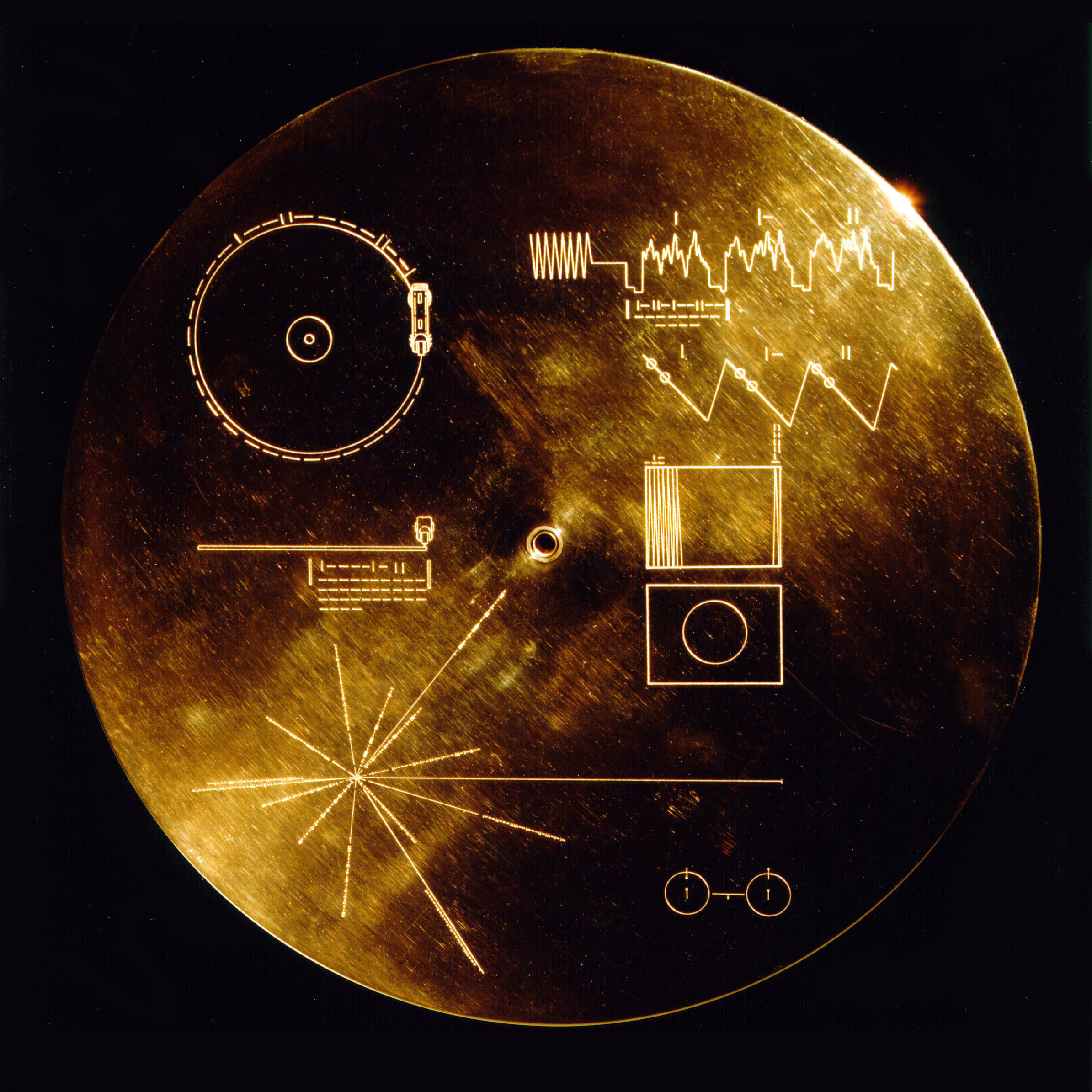
The protective cover is an instruction sheet written mostly in symbols. It does not assume the finder understands English, human numerals or the format of a 1970s record player.
Playback and timing instructions
One diagram shows how to position a stylus and how the record should rotate. Other markings describe the timing reference using the transition of neutral hydrogen, a physical phenomenon that could, in principle, be understood by an advanced scientific civilization. The record was supplied with a cartridge and stylus.
The pulsar map
A separate diagram uses the relative directions and periods of 14 pulsars to help identify the Sun’s location. Pulsars are rotating neutron stars that produce regular signals. The map is a scientific attempt to provide an address for the record’s place of origin, not a guarantee that a finder could locate Earth precisely.
The hydrogen atom symbol
The cover uses a diagram of the hydrogen atom’s hyperfine transition to establish a basic time unit. This connects the record’s instructions to physics rather than to a particular human language.
How is the Golden Record different from the Pioneer plaque?
The Golden Record is often confused with the plaques carried by Pioneer 10 and Pioneer 11. Both are symbolic messages on outbound spacecraft, but they use different media and carry different amounts of information.
| Feature | Voyager Golden Record | Pioneer plaque |
|---|---|---|
| Medium | Recorded disc with encoded images and audio | Engraved metal plate |
| Spacecraft | Voyager 1 and Voyager 2 | Pioneer 10 and Pioneer 11 |
| Message | Earth’s sights, sounds, music and greetings | Diagrams showing humans, the spacecraft and a location map |
| How to interpret it | Requires decoding and playback | Designed to be read visually |
Where are the records now?
Each record remains attached to its respective spacecraft. Both Voyagers have traveled beyond the heliopause, the boundary where the Sun’s solar wind gives way to the interstellar environment. Voyager 1 crossed that boundary in 2012 and Voyager 2 in 2018. The probes are still in our galactic neighborhood; entering interstellar space does not mean leaving the Milky Way.
The Golden Records are not being broadcast continuously. Their survival depends on the spacecraft and the discs remaining intact, and their discovery would require an extraordinary coincidence over astronomical distances and timescales.
Can you listen to the Golden Record today?
Yes. NASA provides information about the record’s music, greetings, sounds and images. You do not need a physical copy to explore the material. Start with the official NASA Golden Record contents and the NASA explanation of the cover.
Those pages are preferable to unofficial playlists when you want to understand which recordings were actually selected. Online reproductions can differ in order, completeness and presentation.
Frequently asked questions
Is the Voyager Golden Record made of solid gold?
No. It is a gold-plated copper disc. The gold coating helps protect the recording surface, but the underlying material is copper.
Did NASA send one Golden Record or two?
Two identical records were launched: one aboard Voyager 1 and one aboard Voyager 2.
Does the Golden Record contain a map to Earth?
Its cover includes a pulsar map intended to help identify the Sun’s position. It is not a conventional map showing streets, countries or an exact destination on Earth.
Have aliens found the record?
There is no verified evidence that an extraterrestrial civilization has found or played either record.
Why is the record important if nobody finds it?
It captures a particular moment in human history: how people in 1977 chose to introduce their planet to a completely unknown audience. It is both a spaceflight artifact and a statement about curiosity, cultural diversity and the desire to communicate.
The takeaway
The Voyager Golden Record is more than a collection of songs. Its cover is a scientific decoding guide, its contents are a portrait of Earth, and its journey is a reminder of how far human-made objects can travel. Even if it is never discovered, the project remains one of the most distinctive cultural artifacts of the space age.
Primary references: NASA Voyager Golden Record overview; NASA contents; NASA cover guide.

Superstar Baseball Codes (October 2026): Lucky Spins and Coins
